
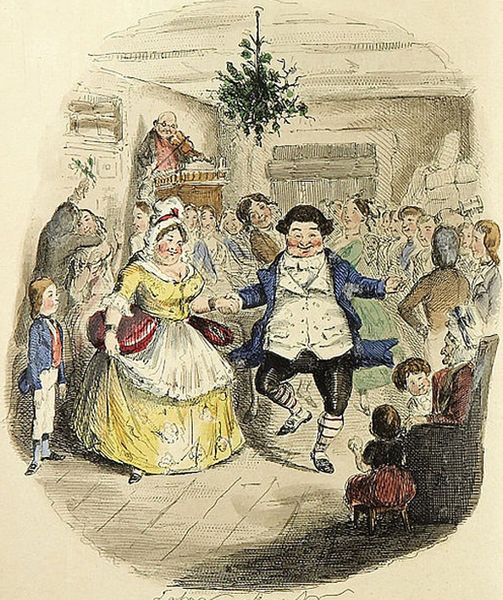
Illustrator John Leech 1843
A Christmas Carol by Charles Dickens
The recording of this talk was broadcast at 8pm (UK) on Tuesday 2nd December.
Ian started his talk with a brief account of the early life of Charles Dickens who was born in 1812. His grandparents had been a butler and a maid, whereas Charles’ father was an assistant clerk in the Royal Navy dockyard pay office, which elevated the Dickens family to the lower middle class.
At the end of the Napoleonic war there was a decline in the workforce required in the naval dockyards and Charles’ father was transferred from Portsmouth to Sheerness where the family, including 5 years old Charles, lived in a small rented house. After a few months Charles’ father was given a permanent job in Chatham Dockyard and the Dickens family moved there.
Charles’ older sister Fanny was musical and appears to have been favoured by their parents as they paid for her to go to school, but there was nothing left for young Charles’ schooling. Charles and Fanny often performed in local taverns but he was not a robust child. Mostly he was left to his own devices, and ‘people watching’, became Charles’ life-long pursuit and the source for the wonderful characters he created in his novels. Ian said that Mr Micawber in David Copperfield ‘was’ exactly Charles’ father as neither could handle money, but both were convinced that ‘something would turn up’!
When Charles was aged 10 he was sent to London, a 3 hour journey on his own by carriage, an early experience that would find its way in to his stories. But the London he arrived in was not yet the gas-lit Dickensian city we think of today but a non-lit Regency city. In 1822, crime in Regency London was rife but the Metropolitan Police were yet to be established and it fell to the parish watchmen known as ‘Charlie’ to police the various London parishes. There was insufficient street lighting which meant that those who needed to walk about at night paid a penny for a ‘Link boy’ to guide them through the streets with a candle lamp. The River Thames was an open sewer and the water brown, yet for the majority of people it was their only drinking water and illness was common.
In 1824 Charles’ father was sent to Marshalsea Debtors' Prison in Southwark and his wife Elizabeth and their younger children went with him. Ian said this was the custom for the dependants of debtors and it made sense since they had no money to live outside prison. Charles and Fanny did not go in to Marshalsea with their parents and younger siblings. Fanny was able to continue her education by giving singing lessons to younger children in her school but Charles had to leave school. He was found lodgings and a job in a blacking factory, which once stood where Charing Cross station stands today. Unfortunately, the landlady was extremely hostile to him. Plus Charles was very alarmed that he was working in a blacking factory with rough lower class people. But the men were kind to him and his father found him new lodgings with a more considerate landlady. He also arranged for Charles to leave the blacking factory. However, Charles’ Mother got the job back for him and Ian said Charles never forgave her and the theme of a vulnerable child runs through many of his stories.
Ian then went on to talk about Christmas customs. Christmas celebrations stem from three main sources. Christian, and the birth of Christ, Roman, and the festival of Saturnalia, and the German celebration of Yule. The birth of Christ was established by the early Christian church as being on the 25th December but early Christians also followed the Pagan winter pursuits, occurring about the same time of the year, as they had been accustomed to. They decked their homes with holly, ivy and mistletoe and a Yule log was brought in to burn in the hearth throughout the festival season. It was thought that mistletoe gave peace, joy, protection and friendship. Druids would lay down their arms and cease fighting until the following day in the presence of mistletoe. Mistletoe was also hung on a cradle as it was thought to protect babies from goblins.
By the medieval era the winter customs had lost their Pagan meaning. Although, during the Puritan era Christmas celebrations were banned as being unchristian. After the restoration of the monarchy some Christmas customs returned but were not quite as they had once been as people didn’t have much time off to celebrate. Queen Charlotte, the wife of George III brought the German custom of bringing a Yew tree indoors. Ian said in one part of Germany it was customary to bring in a Yew tree whilst in others it was a Fir tree. Prince Albert, Queen Victoria’s husband being from the Fir tree part of Germany replaced the Yew with a Fir tree and today the tradition Christmas Tree remains the Fir tree.
Moving on to Dickens writing life Ian said that Charles only had about two years of formal education but he educated himself and when he was able to take out a library ticket he spent many hours in the library reading.
At 15 Charles got a white collar job in a lawyer’s office as a clerk and was also a parliamentary reporter for a newspaper. Ian said Charles had to attend parliamentary sittings and he developed an intense dislike of parliament and politicians whom he blamed for the poor conditions that people lived in.
Ian explained that ‘Boz’, Dickens’ nom de plume, derived from Charles’ nickname for Augustus his younger brother whom he called Moses. But as Charles’ most always had a cold with a blocked up nose it sounded more like Boz.
In 1836 Charles married Catherine Hogarth and was commissioned to write 19 monthly instalments of The Pickwick Papers, for which he received £14 per month. Dickens could write well and had an eye for detail and he always checked the illustrators work, sending back illustrations that accompanied his stories with comments which ensured that the illustrations were returned more to his liking! Sam Weller with his cockney humour turned Charles into a phenomenon. But he needed £9,000 per annum to support his family and he couldn’t live within his means.
Dickens was a great walker and often walked several miles at night through the London streets to gain inspiration for his novels. Ian said that Dickens is known to have walked overnight from London to his home in Kent a distance of over 30 miles.
In 1843 Henry Cole, a civil servant whose job was to encourage use of the penny post commissioned illustrator John Calcott Horsley to create the first Christmas card. In the same winter Charles was in debt despite never taking a day off from writing. His wife was expecting their 5th child, his parents were begging for financial support and he couldn’t pay his mortgage. He badly needed a money-spinner and wrote, in 6 weeks, A Christmas Carol whilst also writing instalments of Martin Chuzzlewit.
Sales were so poor for Martin Chuzzlewit that the magazine was not keen to print anything else by Dickens. So Dickens self-published A Christmas Carol at a cost of £720. But he only charged 5 shillings as he wanted more people to be able to read it. Unfortunately, pirate editions were being published the year after and having priced the book too low he never recovered his costs.
Seemingly undeterred Dickens wrote The Chimes a second Christmas novel in 1844 which Ian said in his opinion is greatly overlooked. For several years Dickens published a new Christmas novel but priced the novels too low and so he never made much money from his novels. Dickens made his money from public speaking appearing not only in this country but he also went to the United States to give recitals. He was a brilliant actor and rewrote sections of some of his novels so they could be perform by him acting out all the parts. His speaking engagements could earn him around £190 (about £20,000 in today’s terms) and he was very popular. But he was still writing novels as well as travelling and he became over worked which led to his death aged 58 from a stroke.
Ian finished by saying that Dickens didn’t so much invent Christmas but he rejuvenated the ancient customs of a bygone age. Merry Christmas!
About the speaker: Ian Porter studied 19th Century Urban Poverty in England at the University of Birmingham and was awarded the Chancellor’s Prize for outstanding achievement. He is currently the guide and owner of London Town Walks and is a highly regarded public speaker and writer on the Victorian East End. He has written a highly acclaimed novel, Whitechapel, set amidst the 1888 murders and is presently writing his second novel, set in the world of suffragettes
Report by: Tricia Baxter