
A Recording of this talk has already been broadcast and deleted as per our agreement with the speaker.
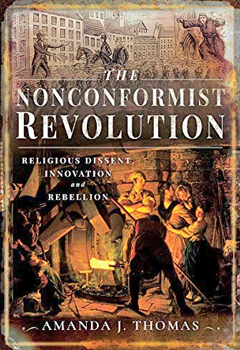
book by Amanda Thomas
Amanda said that her talk was taken from her book The Non- Conformist Revolution and warned us that she had quite a lot to get through on the subject and she would be going quickly. She said she usually does a talk with a book signing but this was not possible for an online talk. However, she checked earlier today and found that her book is available from online book shops for as little as £11.48.
The inspiration for her book started when she discovered that Simon Osmotherly, a roundhead and Quaker, was an ancestor. Also why some people value education and some do not Amanda finds intriguing and non-conformists valued education. Many Industrial Revolution greats, whose names we know today, were non-conformists which Amanda also found intriguing.
Amanda asked, “So, What are non-conformists? “
In answering her question she explained that Non-conformist are Protestants who do not believe in the doctrines of the established church. That is the Church of England and before that the Roman Catholic Church.
Amanda said that her book starts in the 14th century, a period which shook many people’s religious beliefs with a series of catastrophic events. Such as the great famine, from 1315, caused by a super volcanic eruption affecting the world’s climate, and the black death, from 1347, which killed over a third of the population of England. The tithe was increased despite rural poverty and people were asking why God had allowed all this to happen?
Lollards - one of the preachers talking about new ideas in the 14th century was John Wycliffe, who in 1382 published the first Bible in English. Previously the Bible been in Latin and had to be interpreted by the clergy. The followers of Wycliffe’s new ideas were known as Lollards. They challenged Orthodox beliefs of predestination, salvation and transubstantiation (that during holy communion bread and wine really turn into the body and blood of Christ) They also questioned the wealth and authority of the church, the monastic orders and the clergy. Also they rejected most of the catholic traditions such as pilgrimages, idolatry, indulgencies, candles, holy water etc. They saw these traditions as being invented by men and not by God and saw no reason why a person had to speak to God via the clergy.
Amanda continued to name many other non-conformist sects giving a brief description of their ideology and practices.
Separatists – were 16th and 17th century dissenters who separated from the Orthodox Church, which they felt was corrupt and should be founded by the Holy Spirit not people. They challenged the divine right of Kings and had to go to The Netherlands to freely practice their beliefs. Some Separatists went to America on The Mayflower.
Anabaptists - started in the 16th century and thought you needed to be an adult and choose to be baptised. They were also against war.
Calvinists - an early group founded by John Calvin in Geneva. They believed only those elected by God can attain salvation. A theological issue discussed many times over the years because how do we know if we are elected?
Congregationalists -founded by Robert Brown in the 1580s had their origins in the Separatists although they were Calvinist in thought. Their churches were self-governing and education was a priority.
Lutherans -began in the 16th century with Martin Luther and the German reformation. They thought the Bible was the only authority, believed in transubstantiation and that only those who have been baptised have direct access to God.
Presbyterians - a reformed version of Calvinism founded in Scotland in 1560 by John Knox who was a disciple of John Calvin. They believe that the Bible is the authority and salvation can only be achieved by good works and the grace of God.
Baptists -founded in Amsterdam in 1609 by John Smith a Separatist. They believe adults need to choose to be baptised and that a person is responsible to God, to whom they can speak directly.
Quakers -founded in 1640/50 by George Fox. Early followers included Amanda’s ancestor Simon Osmotherley. Amanda says she has written quite a lot about Quakers in her book because of their involvement in trade and commerce. They believed in silent prayer and that you can talk to God directly. They were against slavery but believed in the equality of the sexes, hence many of their early preachers were Women.
Unitarians -founded in the late 16th century in Eastern Europe, were established in 1774 in London by Theophilus Lindsay. Many great thinkers and scientists were followers.
Methodists – founded in the 1730s by John Wesley whose philosophy they follow. They believe in infant baptism, holy communion, that the Bible is supreme and salvation can be achieved by everyone through good works. Being an inclusive group they had many followers from the working classes.
Plymouth Brethren – founded in the 1820s they followed strict moral practices, belief in the Bible as the true word of God, but separated themselves from non-members.
Amanda said there are other groups but those were the main Non-conformist sects and common to most of them is that they really valued education. Non-conformist’s thoughts very much paved the way for innovation, which was enhanced by literacy, education, enlightenment, and unfettered, thinking.
Amanda continued her talk by describing the way education began to flourish not just with the upper classes, but also in the middle levels of society where children, both boys and girls, were being taught to read and write by their Mothers. Boys in the agricultural communities were behind girls in writing ability as they started work about the age of 6 or 7 whilst the girls were working in the home and were still able to learn to write. Middle class boys could attend grammar schools although girls did not attend schools in this era. The number of horn books and pamphlets in circulation is evidence that literacy was widespread.
Disseminating ideas along trade routes to London and back where people such as, chapmen, peddlers and carriers, traded goods including books and pamphlets. Cloth making areas were connected to each other and walking the same routes were preachers all meeting up at inns, market squares, fairs etc to share the new ideas.
Amanda remarked on the cloth making areas in Europe with the many migrants who settled in the Kent and the country having first been invited by English Kings and later arriving due to religious persecutions in their home country and bringing with them new skills and new ideas. As years went by swapping new skills and new ideas continued in the manufacturing industries of the Industrial Revolution.
Amanda continued naming many of the Industrial greats who were non-conformist and showed family trees where they were intermarrying with one another. Plus they were setting up Societies such as the Lunar Society founded by Matthew Bolton with Charles Darwin’s grandfather Erasmus Darwin. The Lunar Society so called as it was held on the night of the full moon to enable their journey home easier, had many famous members, household names today.
Josiah Wedgewood the famous pottery manufacturer was an innovator and we can still see his notes and experiments in the Wedgewood Factory's Museum today. Wedgewood’s father was a Unitarian minister. James Watt the engineer, who inproved on Thomas Newcomen’s steam engine, was a Presbyterian. Whilst Newcomen himself was a Baptist and a lay preacher. Richard Cadbury the linen maker, was father of John Cadbury of chocolate fame, they were both Quakers, as was Abraham Darby the iron maker.
There were many more famous industrialists who Amanda said had chapters in her book but this talk had been a whistle stop tour covering as much as she could of such a large subject in an hours talk. Those needing more details she again suggested they should read her book: The Non- Conformist Revolution.
About the speaker: Amanda J. Thomas is an alumnus of the University of Kent at Canterbury. She is an author, broadcaster and historian with a particular interest in social and medical history. She has been involved with the BBC television series Who Do You Think You Are? Editor of the historical journal, The Clock Tower, for The Friends of Medway Archives (FOMA). Amanda is also a member of Kent FHS and has been a judge for the Alan Neame Award, an international writing competition organised by the Kent Family History Society.
Report by Tricia Baxter