
A recording of this talk was broadcast on 4th August 2026 at 8pm (UK).
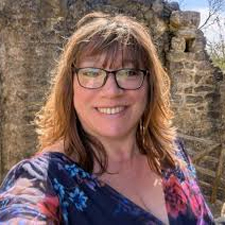
Claire started her enthralling talk by relating how she first became interested in Witchcraft. This was during her A-levels when studying Arthur Miller’s The Crucible about the Salem Witch Trials and she was of the opinion that they were just women in the wrong place at the wrong time. But this led her to become interested in the history of British witches and to visit a number of places associated with witchcraft.
Her interest was really piqued when, on a family holiday in Cornwall 14 years ago, she visited the Museum of Witchcraft in Boscastle. Amongst the exhibits was a long list of women executed for witchcraft during witch hunts and to her surprise several were from her home town Maidstone. Up until that point Claire had never heard of anyone involved with witchcraft in the Maidstone area? Her appetite was further whetted as one lady was called Anne Martin which happened to be the name of her 4x Great grandmother. Although, the Anne Martin on the list didn’t live in the same time as Claire’s 4x Gt Gran, hence she was obviously not an ancestor.
Over the years Claire began to delve deeper into the history of witchcraft in Maidstone including the local women on the list in the museum at Boscastle. And, a couple of years ago she and some friends were inspired to launch a campaign for a memorial in Maidstone to remember those who died having been persecuted for witchcraft. Claire’s research took her from the Kent Archives at Maidstone to the National Archives at Kew where she was able to see and hold the original Assize records of the big witchcraft trial that took place in 1652.
The word witch comes from Old English wicca for a male and wicke for a female being first recorded in King Alfred’s laws in the 9th century. At that time the terms covered a wide range of people such as: diviners, seers, healers, wise women, midwives, soothsayers, sorcerers etc. By the 15th century the terms had merged into one word mostly referring to women who it was believed practised magic whether for good or evil.
In many cultures throughout history people looked for those in their community who they thought might possess ancient knowledge to interpret omens, practice divination and perform healing. They were respected for their abilities but they were also feared for their supposed powers. Up until the 14th century the local healer, herbalist, midwife, and those who prepared natural remedies to provide healing for their community may have been perceived as witches but they were not ostracised for it. At a time when few could afford the services of a professional doctor or nurse all levels of society would go to these wise people for medical help and in return they were paid with goods such as food.
In the Tudor and Stuart period apotropaic or witch marks common in mainland Europe start to make their appearance in Britain. People thought these marks would protect houses from the devil and evil practises. People then started to perceive healers, especially women, as working with the devil. Apotropaic marks dating from the early 1600s can still be seen today in Knole House, Sevenoaks and Ightham Moat, Kent having been found during restoration of those buildings. Claire showed images of a witches marks and one which is still visible in the bell tower of All Saints Church, Maidstone.
In 1486 a book titled Malleus Maleficarum (or Hammer of the Witch) was published. It was written by Henrich Kramer a German catholic monk, who was a failed witch hunter, and possibly a misogynist too. This work was a ‘how to guide’ in the identification, capture and torture witches. It describes women as most likely to be tempted by Satan because of their ‘uncontrolled sexuality’! Kramer had some very strange ideas such as suggesting women made pacts with the devil and kept nests of penises in trees! This book printed on the recently invented printing press just a decade after the Spanish Inquisition went viral.
Claire continued giving several accounts over the centuries which were put down to witchcraft getting closer to Kent and eventually to Faversham just a few miles from Maidstone which led to the witch trials in Maidstone in the early 17th century.
Other ways to prove if someone was a witch were ‘witch prickers’ that is long thin needles as one of the beliefs was that a witch would not bleed, whereas non-witches would. But it was a deceitful way of getting proof as the needles were retractable so there was little chance of being found not guilty. The same is said of the sink or swim test. But Claire said she was myth-busting the cucking or ducking stool as her research had found little evidence that they were used for detecting witches. Ducking stools were mainly a punishment for women accused by men of being scolds. In the sink or swim method of determining a witch the person’s thumbs were tied to their opposite toe with a rope which was then tied around their waist. If they sank they were innocent but had most likely drowned. If they floated they were guilty and taken to the gallows to be hung!
The sentence for witchcraft in England was usually death by hanging. Scotland and mainland Europe favoured burning witches as it was thought that fire would purify the evil. If they were lucky they were strangled first but to make it more horrifying greenwood was often used as it burnt slowly.
Several women were able to avoid the death sentence by being pregnant or as it was termed ‘pleading the belly’. They would be examined by midwives or matrons to prove if it was true. But the child in the womb would need to be beyond the quickening stage to be detected.
Claire showed a drawing of the town hall at Maidstone around the 17th century and compared it with a modern photograph to show where the prison once stood. Claire said the remains of the prison when taken down was reconstructed in an upper floor of the nearby town hall when that building was rebuilt. The town hall after reconstruction looks pretty much as it once did as Claire showed in comparison between the drawing and photograph. There is considerable graffiti carved into the floorboards and behind the door of the cell, which has an open window which would have looked out onto the street. If you were lucky your friends and family could pass food and drink to you through the window but also anyone could and did throw stones, rotten fruit etc at the prisoners through that window. Claire said the prison cell can still be viewed by arrangement with the town hall.
The cell was about 14 feet square and could get very full. In 1652, 35 people were packed in this cell accused of burglary, murder, theft etc as well as witchcraft. At an earlier witchcraft trial 156 people were imprisoned. When it got physically impossible to house more in the cell they were kept in an open wooden cage nearby at the mercy of the elements and vigilante carrying out their own ‘punishment’.
Before arriving at the big trial of 1652, Claire related several stories of those on trial for at Maidstone for witchcraft. Assizes were held several times a year in the country on a circuit at Rochester, Dartford, Canterbury and Maidstone. The people accused of witchcraft on trial at Maidstone came from places nearby such as, Boughton Monchelsea, Boxley, Cranbrook, Dartford, Lenham, High Halden etc. They were accused variously of using witchcraft to damage crops, kill livestock, bewitch sheep and humans often to death and that the devil or a spirit had entered them and gave them great but evil powers.
Claire talked about the history of Penenden Heath, where the gallows were situated and where the guilty were taken to be “hung by the neck until dead”. The name Penenden is thought to derive from pinyon an Anglo Saxon word meaning to punish. Hundreds, if not thousands of Maidstone’s townsfolk would turn out to witness the event. They looked on it as a day of entertainment and in the alehouses told grisly tales of how the ‘guilty’ had met their end. Why and how it happened Claire said is another talk and there isn’t time to go into it today.
Claire ended by saying: “I think we can be pretty sure that these women and others like them were just innocent women who were in the wrong place at the wrong time.”
There was a very lively question time after the talk. The memorial to these women will most likely be in Maidstone Museum where a description of the women and what they were accused of can be explained.
The Maidstone witchcraft trials were recorded by an eyewitness in a pamphlet published the same year and can be read online via Oxford University’s Oxford Text Archive:
‘A Prodigious and Tragical History of the Arraignment, Trial and Confession and Condemnation of Six Witches at Maidstone in Kent’ by E.G. Gent.
Report by Tricia Baxter