
The Live talk took place at 10am (UK) and the recording was broadcast at 8pm (UK) on the same day.
The start of Philip’s talk was considerably delayed when his laptop’s sound system failed and he had to fire up a new laptop and transfer his presentation to it. Meanwhile, Members were able to chat in a ‘breakout room’. But, despite the wait no one left and several members mentioned after that the talk had been well worth the wait.
Philip started by describing in brief how and when the seven Royal Dockyards in England and one in Scotland came into being. The very first Royal Dockyard in the country was at Portsmouth, and dates from the time of Henry VII. Chatham started out in 1570, during the reign of Elizabeth I, and at first was quite small. However, by the 17th century due to wars with the Dutch, when threats of invasion were focused from the North Sea, Chatham grew extensively. In the Victorian era there was a major expansion which doubled the size and made Chatham the largest of all the Royal Dockyards.
Kent had four dockyards at Deptford, Sheerness and Woolwich as well as Chatham. In the days of sail, Chatham was not easy to access as navigating the turns in the river Medway to reach Chatham could take three weeks. Consequently, Sheerness Dockyards took on minor repairs so that Chatham could concentrate on major repairs requiring a dry dock and a longer stay in port. New ships were also built at Chatham and the dockyard was responsible for building over 200 warships in the age of sail. They also built covered facilities over the docks which allowed them to hasten the seasoning of new wooden ships (which could take up to 5 years) to six months. Of the many Royal Navy ships built at Chatham some have famous histories such as HMS Victory, which is now in dry docks at Portsmouth.
The Crimean War (1854-56) saw the start of iron ships being built due to wooden ships not being able to withstand the Russian Army’s advanced armaments. Although, the war had finished by the time the first iron hulled ship, HMS Achillies, left its dry dock at Chatham in 1863.
Employees at Chatham numbered in the region of 1,500/2,000 in the Napoleonic War era but then declined until the Victorian extension, when employees had increased to 5/6,000. At first convicts serving hard labour sentences were used to build the extension. But the convicts productivity was poor, as they were unwilling workers, and so they were replaced with paid employees. The number of dockyard workers at Chatham reached its height by the end of WWI giving over 20,000 persons employment.
The Navy was a very strict employer with Men and Women segregated. Even the times they arrived and left work were never the same to ensure there was less chance for the sexes to mix. Lateness was not tolerated and to ensure everyone was at work on time the dockyard gates were promptly shut at the start of a shift and no one was allowed in afterwards for any reason.
During the Press gang era Dockyard workers were issued with an exemption certificate so they could not be pressed into service as a sailor. You may find the certificates in personal archives as men carried them on their person and there is a Register at TNA.
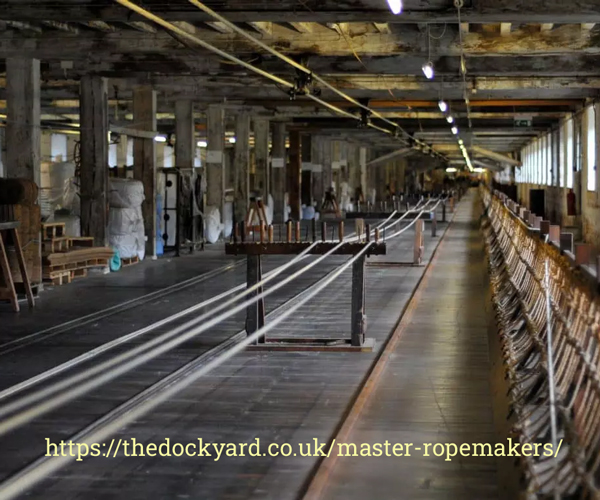
There were many different occupations in the dockyard from labourers, apprentices to qualified tradesmen. Philip went through some of the trades. On sailing ships Rigging and masts were most important with the average ship requiring 25 miles of ropes which needed renewing every 3 years as salt water erodes rope. Hence the Ropery was built at Chatham which is still actively producing ropes for sale today. Philip described how ropes were made and tested for strength. Females were employed in the Ropery and known as Women of the Ropery whilst those employed in the sail and colour loft were known as Ladies of the Colour and Sail Loft. The latter mostly being the female dependants of deceased Naval officers. The terms ladies and women were a class distinction in the 1820s with females referred to as ladies being seen to be more respectable in society than those called women.
Another major trade were Ironsmiths producing anchors in the dockyard. The work was so hot that it was not carried out in the summer months and Smithies were allowed to drink 8 pints of strong beer every day. They were the only employees allowed to drink on duty.
Philip said records for the Navy Board are immense and gave details about where to look for them. He said they were mostly in the ADM 106 collection at The National Archives at Kew but others were held at the National Maritime Museum at Greenwich ADM 354. Philip said try searching a name or other keyword. The Navy Board records are being digitised and chances you will find someone are improving.
Various Records in the series ADM 106 (1650-1837)
Chatham Artificers (alphabetical) ADM 106 /2975
Yard Pay Books for:
Chatham Ordinary 1801 ADM 42/92
Chatham Extraordinary 1801 (workers away from the dockyard). ADM 106/247
Artificers dismissed (1784-1811) ADM 106/3008-3007
Register of protection from being Pressed (1794-1815) ADM 7/377-80
Use TNA's Search Guide to look for dockyard staff employment pensions etc.
Report by Tricia Baxter