
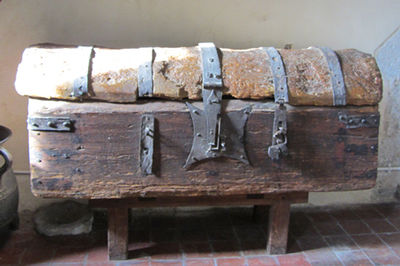
the church registers and
parish papers were once kept
This will be our last hall meeting for 2025. We will be meeting again 'In person' on the 2nd Friday in the month from Friday 13th March 2026.
Branch members were very pleased to welcome back popular speaker and Kent FHS’s President, Peter Ewart. Branch chairman David Wood reminded us that for many years it was Peter who started the branch annual programme with the February talk. Although, this evening, Peter will be giving the final talk of 2025, and undoubtedly the last talk for the branch at St Andrews as the branch needs to find a more cost-effective home if we are to continue meeting in person.
Peter started his talk by asking, “Are parish registers a suitable source for Family Historians?” He went on to say that he had been a genealogist for over 50 years and before the digital era always handled the original documents and has found that parish registers are as prone to fallibility as any other record out there. He felt that newcomers to family history today are not as rigorous in their research as researchers were 40/50 years ago. Mainly because today’s researchers are spoon-fed online and often don’t see an original document to understand the why’s and wherefores behind them and you don’t know what you don’t know! Peter impressed on us that we do need to look at original documents for ourselves, albeit on film, as due to constant handling nowadays registers are rarely offered to researchers. Peter continued his interesting talk by giving the dates of major changes to the keeping of parish registers and pitfalls to look out for.
1530 - Henry VIII ordered all parishes to keep a written record of Baptisms (not births), Marriages and Burials (not deaths) but remember that registers, or microfilm of the registers, you are looking at today are not original registers. That is because in:
1597 - Elizabeth I ordered that all registers should be rewritten into a book with parchment pages. Now we can appreciate why so many early registers appear to be so neatly recorded for several decades in the same hand. But how many copy errors might have crept into the rewrites, adding to any mistakes made by the original complier. Unfortunately the old registers were discarded after being copied and no longer around for us to check. In the early registers mothers names were mostly left out and a few others left out the Father’s forename too.
1598 - Elizabeth I ordered the parish to make copies of their registers every 6 months to be sent to the Bishop of the diocese in which the parish was situated. We are lucky in East Kent that Bishops Transcripts [BTs] for the Canterbury Diocese are the best kept in the country. It is good to check the parish registers [PRs] against the BTs although as these were written on loose sheets some will inevitably have gone missing or been lost. BTs and PRs should mirror each other but sometimes they don’t and if in doubt as to which is correct it's probably better to go with the entry in the PRs and try to check it some other way, perhaps with a family Will.
1604 – James I & VI reminded parishes about previous orders of Henry VIII and Elizabeth I and that registers should be completed within 7 days of the events. The names of both parents for baptism, and for marriages the full names of both participants and the witnesses should also be recorded. Registers were to be signed by the Minister and the Churchwardens as well as the copies made for the Bishop.
1640 – A new ruling was that the date of birth was to be recorded alongside the baptism entry and in the burial register the date of death alongside the burial date.
1642 –The Civil War and the following years there will be gaps in the registers of about 19/20 years. As during the rule of the Commonwealth Parliament registers were taken away from the church and given to JPs and Magistrates to upkeep. Marriages were well recorded with additional information but most all Baptisms and Burials were not recorded in the register in those years and there were no BTs either.
1661 – restoration of the monarchy in England as Charles II is invited back. Registers were supposed to be returned to the parish but some never found their way back. There were efforts made to record missing entries but it’s a bit of a mess as their accuracy can’t be assured when recorded so many years after the event.
You may see entries ‘private’ or ‘at home’ this may have been because the Rector visited the home, to carry out the baptism, for a variety of reasons. But as you should not be baptised more than once don’t look for another baptism in the church.
In burial registers you may spot ‘Aff’ or ‘Affidavit’ this is to indicate that the person being buried was wrapped in a woollen shroud. A fine of £5 was made if the person was buried wrapped in anything other than English wool. Of course the rich could just pay the fine. Half went to the informer, usually the relatives of the person being buried, and half to the parish. The idea was to help the English wool trade but Peter said it did not go on for long and it did not make much difference to the wool trade.
Baptisms, especially of the eldest child was often held in the Mother’s parish. So if you can’t find it in the parish they were married try looking at the registers for her parish.
1711 - Registers of baptisms and burials had to have a margin drawn on one side in which the Surnames were to be recorded against the relevant entry. Peter warned us not to scan down the Surnames too quickly as you can miss valuable information.
1731 – The use of Latin was legally stopped. All documents in future to be in English.
1751/52 – change from Julian to Gregorian calendar. New Years Day moved to 1st January. It had been 25th March hence the three months that now start our year [January, February and up to the 25th March] were previously at the end of the year prior to 1751. The use of double years before 1751/52 is to indicate this. Also to align the Julian and Gregorian calendars 11 days had to be ‘lost’. So don’t look for your ancestors’ significant happenings from 3rd to 13th of September 1752 as those were the 11 ‘lost’ days.
1753 - Clandestine Marriage Act also known as Hardwick’s Marriage Act set out to stop marriages, which were illegal or barely legal, such as those taking place with a clergyman who did not ask too many questions. Marriages now had to be by Banns or Licence, there was to be two Witnesses of the same generation as the couple to be married, as they were more likely to be alive to give witness years later. We now get more documents such as Licences, Allegations, Bonds, Applications. Banns had to be called on 3 consecutive Sundays. Peter quoted a case in Cranbrook where the groom ran away after the Banns had been called but before the marriage took place, leaving the jilted bride to give birth out of wedlock. This was a case of Breach of Promise which was observed into the 20th century. Beach of Promise and Bastardy cases were heard at the Petty Sessions and details may be read in the Minutes.
Wife Sale – At a time when divorce was difficult or expensive for most of the population it was a way of telling everyone in a public place that the husband was no longer responsible for the wife or her debts, which were now the responsibility of the purchaser. Peter gave an instance where a wife had been sold at an Inn as it was not market day. The purchaser had usually made a prior agreement with the husband and wife to purchase the woman.
1837 – Marriages had to record the father of the bride and groom and their occupations
Peter gave an instance in his own family where a man was baptised as an adult after his sons had grown up and you might easily presume that the man's baptism was a much younger son. He ended with the famous quotation by Sherlock Holmes “When you have eliminated the impossible, whatever remains, must be the right". No! Assuming an entry must be correct is not right! So always exercise caution in your research at all times.
About the speaker
Before retiring Peter Ewart was a professional genealogist. He is now Hon. President of Kent FHS and a very popular speaker at society events.
Report by Tricia Baxter