
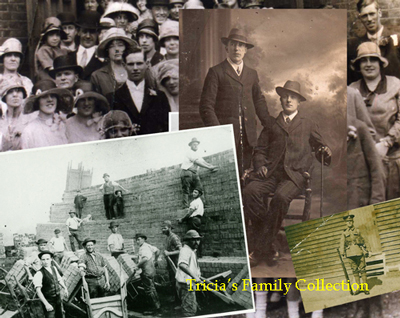
 Tom Doig, has been a teacher and a Social Historian in Cambridge as well as working in museums dealing with old photographs.
He told us that many museums have old photographs in their collections but many albums had no dates or identification written on them and asked, “Then how do you identify the dates of a photo?” The audience suggested from the clothing the subjects were wearing. But Mr Doig asked us to date the clothes that we were wearing that evening. Few of us would be wearing clothing bought that year, he certainly wasn’t and some could have been bought some time ago. Therefore, dating an image by the fashion of the clothing worn in the photograph would be an inaccurate way of identifying the date it was taken. It was important therefore to look at other details about the photograph. In the early days of photography the frame was a good indicator of date as the design and materials used were often limited to a span of a year or two. Demonstrating this he showed several slides of photographs starting with the late 1840s and described the development of the frames and the materials used over the following 60 years. Materials varied from glass, cardboard, metal, plastic and Bakelite and 998 different designs have been found mostly in the USA.
Union Cases were invented in 1854 and were used to carry photos around to show them to family and friends. We were shown a photo of a very young boy taken in the late 1850s when both sexes wore dresses, and of a lady taken in 1858/59. Frames were of different shapes and sizes and they improved in 1859/60. Those of this era are fairly common. Mr Doig advised anyone with a photograph of this era not to remove it from its frame or try to clean off the black backing as the photograph could be irreplaceably damaged. In 1858 a casing/cover, made of plastic, was introduced in this country by Samuel Wood.
In 1857 France introduced a new type of smaller frame (2 ½ x 4 ½ inches). These could be used for business cards and would show a gentleman dressed in a smart jacket portraying a sign of affluence.
At first only one original image was taken and you can tell copies as they would show specks of dust! Then multi lens cameras were used taking copies using a copying frame until negatives were introduced in 1863.
Props were often used in photos and also clothes, provided by the photographer, for weddings etc as some people could not afford nice garments. Sometimes the clothes would have creases because they had been folded up and stored. It was also important that photographers always had to latest equipment throughout their career. But despite the occasion people usually looked miserable and were staring at the camera. This was because the exposure time could be 2 or 3 minutes; a long time to hold a smiling face!
Some images could be dated if they contained images of royalty. But in 1872 Queen Victoria had a bill put through Parliament to stop people using the Royal family name unless they had a warrant to do so.
In 1886/87 a new style and different size of photo was introduced. Apprentices would often have their photo taken to mark the end of their apprenticeship. The clothing worn in the image Mr Doig showed us identified the young man as an Apprentice photographer as they wore distinctive trousers rather like those a chef might wear today. Bereaved parents had photos taken of their deceased babies. But live babies were not an easy subject to photograph due to the long exposure times when they needed to be still. So special chairs were used to hide the mother‘s arms holding up the baby. Mr Doig proved this by showing some poor photography where the photographer had not managed to entirely hide the mother and other props they had used.
In 1908 school photos were introduced, usually taken in October during the quiet season. They were often stamped with the place on the back. However, this was more often a different place to where the school was located because they sent the films to other towns for processing. Travelling photographers took pictures at various places such as markets and again props were used for backdrops.
Family albums were popular but in order to fill up all the spaces in an album a photographer would use photos of well know people. This could be quite misleading to family historians who may conclude that the celebrity was part of the family in the rest of the album.
After questions Tom Doig kindly helped members to date their own old photographs.