
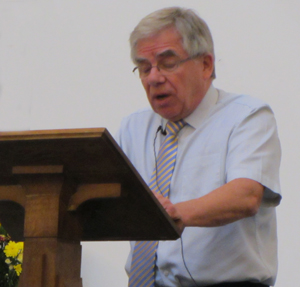
Branch chairman David Wood welcomed everyone to our new hall at Lower Hardres and went over the reasons for the move and the need for now charging entry to meetings for KFHS members as well as guests.
David then introduced our speaker, the ever popular Peter Ewart, who is our Society’s Hon. President. David reminded us that it was Peter who gave the final talk in our old hall last year and he had kindly come out of semi-retirement to give this evening's talk. Peter showed many interesting slides in his excellent presentation including cartoons satirising the Victorian Poor Law system.
Peter started by asking “Why ‘Victorian’ Workhouse?” and went on to explain the need, in the 19th century, to make changes to the Elizabethan Poor Laws. The Elizabethan Poor Laws had been a sophisticated system based at parish level but having serving the poor well for several centuries they were not coping well with a greatly increase population, especially in towns and cities.
The Elizabethan Poor Laws had a completely different approach to dealing with the poor. Elderly and others who could not look after themselves at home or were homeless were looked after in the parish Poor House. This was a much smaller building, more house sized, than the Workhouses built by the Victorians. Under the Elizabethan system those ‘in want’ did not always need to come in to the Poor House if they could be helped at home over their time of distress. Whereas under the Victorians there was only relief for those in the Workhouse. The Elizabethan system required two Churchwardens per parish to collect taxes from those owning land and property in the parish. This was then used to help those in want and need in the parish.
But, by the Victorian era, the Elizabethan Poor Laws were ‘creaking at the seams. The population increase had become disproportionate, with a small number of parishioners paying into the system to be shared amongst a larger number of poor requiring help. There was pressure on the government to do something about it.
Several towns and cities like Canterbury had already been given permission in the 18th century to form parish unions within their locale so they could jointly help the poor. A new Poor Law was drafted in 1834, under which all parishes in the country were formed into unions with one Workhouse. Now parishes were told to sell off their Poor Houses and direct their poor to the Union Workhouse. One of Peter’s slides showed a map of the Kent Unions. Several Unions had their Workhouse centrally placed within the parishes it served. But this was not always the case and could mean a walk of 30 miles or more to reach the Union Workhouse assigned to their parish. Despite being closer to the Workhouse in another Union the poor could only go to the Union Workhouse their parish was associated with. Consequently itinerant tramps or vagrants would be refused entry to a Union Workhouse if it was not associated with their home parish.
It was not compulsory to enter a Union Workhouse. You could leave when you wanted but there was no benefits system in the Victorian era, the attitude of the time was that it was their own fault that they were poor. Plus many Victorians thought the system of care was far too soft and people would take advantage of it and not work. It was also thought that the demon drink was the root cause of so many destitute people and many cartoons were produced lampooning the subject. However, for those in want and need during the Victorian era there was no safety net they could turn to other than the Union Workhouse.
The layout of nearly all Victorian Workhouses observed the same principles. Upon entry families were broken up. Able bodied Men and Women were assigned to separate wards and recreation yards and segregated from the disabled who had their own facilities. Husbands and wives were kept completely apart so they would never meet, probably again in this life if one of them died in the Workhouse. Children were taken away from their parents, and even new born babies separated from their mothers. Children had their own wards and recreation areas with a school, long before the compulsory education Act came into being in the latter part of the 19th century. In the Workhouse school children would be given a basic education enough to be employable so they could be put out to work.
It was no use bringing personal possessions because when you arrived at the workhouse everything would be taken from you, including the clothing you were wearing. They were fumigated and put away to be given back to you when you were able to leave the Workhouse. You would then be required to wash before being given a Workhouse uniform to wear.
Peter showed a slide giving a weekly menu for inmates in the Workhouse which was very repetitive and was just about enough to keep inmates alive, as food and clothing all had to be costed out to the penny. Beer was served except on days when gruel was on the menu, which was more often than not. The new Poor Laws were often referred to as the ‘New Starvation Laws’ by non-conformist groups. Several Victorian authors mention Workhouses in their books. Most people will know that Charles Dickens featured the Workhouse and the life of the poor in several of his books, having had first-hand knowledge of his family being poor in his childhood.
Local papers of the period report the meetings of the Guardians of the Poor, usually a committee of worthy and well established gentlemen. Birth and Death Registers were kept by the Workhouse. They were aptly named ‘work’ houses as they were to be a place of industry. Inmates were expected to grow produce for use in the Workhouse, work in the kitchen or other labour such as cutting up faggots.
Things did start to get better as the 19th century wore on. Worthy people might invite the inmates to their gardens on a Sunday afternoon where the inmates would be given better fare than they were used to eating in the Workhouse. Soup kitchens were set up and also offered breakfast for a 1d and that could be just enough help to keep people out of the Workhouse. Philanthropic people started Ragged Schools to get urchins off the street and hopefully save them from a life of crime. Several charities including the Jews from the East End gave help to the poor which kept the Workhouse numbers down. Peter showed several photos of rows of men eating and another of women having a meal, they were not allowed to talk to each other during meal. The look on the faces of the people was one of dispair
In 1860 it was decided that having only ‘in relief’ was rather silly when ‘out relief’ to tide someone over for a few days would allow people to stay out of the Workhouse. There was also a change to the style of public building architecture in the 1860/70s which benefited the Union Workhouses buildings by making them look less like prisons. Vagrants and casuals were accepted for bed, board and work but in big cities they were oversubscribed and closed their doors as soon as they were full. Peter showed a slide of sleeping men in box like coffins, they were crowded together with no spaces between.
But the population started to discriminate between the undeserving and deserving poor. They were discouraged from helping beggars but encouraged to report them. Unfortunately, despite changes to the system some people in need remained outside the system.
In 1929 an Act abolished Workhouses. Orphanages and Industrial Schools were set up for children and Mental institutes all of which have records the latter showing details of treatment, although they can’t be seen before a 100 years has passed.
In 1948 the NHS was started and many former Workhouses became hospitals. Unfortunately, they were greatly feared by the elderly as they never lost the stigma of once having been a workhouse.
Report by Tricia Baxter