
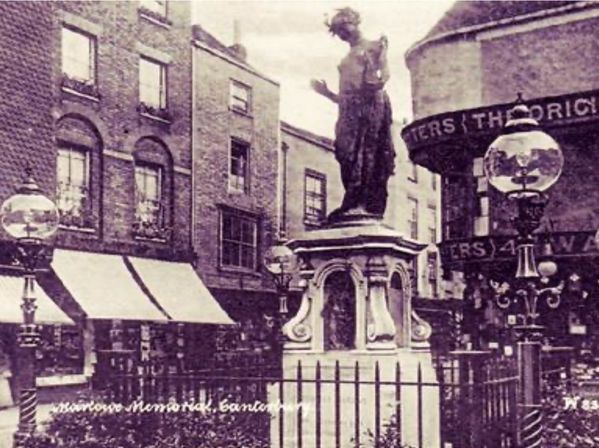
The Buttermarket Canterbury
Ian Osterloh is Secretary of Canterbury Historical and Archelogical Society, a Canterbury City and Cathedral guide and also a member of Kent FHS. He gave branch members and friends a very amusing and informative presentation about the locally nicknamed Kitty memorial, currently standing in The Friars in front of Canterbury’s Marlowe Theatre. The memorial celebrates the talents of Kit [Christopher] Marlowe [1564 -1593] the city’s famous playwright who was born and bred in Canterbury.
Starting with a short profile by way of an aide-memoire Ian reminded us about Marlowe’s life. His birthplace was bombed in WWII and now lies under the store Fenwick’s in St George’s parish where Kit was baptised in 1564. Kit's education was at The King’s School Canterbury followed by Cambridge University. He died aged 29 in Deptford. Or as Ian asked … Did he? Some people think Marlowe’s death was a conspiracy and that he lived out his life in Europe.
In Victorian Canterbury there appears to have been little known by the citizens about Marlowe so it was little wonder that no memorial had been erected to him previously. Ian told the tale of how the idea of the memorial was suggested by Frederick Rogers of the Elizabethan Society and backed by many Victorian poets and literary greats whose names we know today such as Sir Henry Irving. These people formed a committee but apart from their donations and a few from the city fathers there was little local interest to fund a Marlowe memorial from the citizens of Canterbury. In the end only enough was raised for the Muse on the pedestal at the top of the memorial and one statuette, with the hopes that the city would provide the other three statuettes in due course.
When it came to the design, we may wonder today why there is semi-clad female on top of the memorial and not a representation of the man himself? Ian said the official reason was that no one knew what Marlowe looked like as the famous painting of Kit did not suface until the 1950s, hence they chose an allegorical subject. But there are other possible reasons – such as his alleged atheism, which would be shocking to many Victorians
The chosen sculptor, Edward Onslow Ford, was recommended by Henry Irving and Ian told the tale of how Ford attended Irving’s performances and sculpted a bust of the actor in the dark to convince Irving and his manager of his abilities.
The statue was unveiled in The Buttermarket on 16th September 1891 and was not universally met with praise. There was some concern over the smallness of the crowd attending the ceremony but Ian showed a photograph of the occasion which showed what seemed to be a reasonable number of people in attendance. The only statuette was of Sir Henry Irving dressed in the role of Tamburlaine, a role he is never known to have played. Several locals thought the Memorial was to William Marwood the executioner, who developed the ‘long drop’. Why would a memorial have been erected to him Ian wondered as Marwood never had the strong connexion with Canterbury that Marlowe had.
After WWI it was decided that a War memorial should stand in The Buttermarket and in 1921 Marlowe’s memorial was moved to the Dane John Gardens. In WWII the muse was blown off the pedestal during an air raid and eventually replaced, but facing the wrong way around! The other three statuettes did follow in due course. But over the years all the statuettes have suffered several thefts and replacements.
In 1993 the memorial was moved to The Friars where it stands today. Ian showed a photo of the memorial in 2023 when it looked a little unloved as the muse was shrouded in foliage from an overgrown tree. Although the muse is now visible she still does not quite face in the direction she did when unveiled in 1891.
Ian completed his talk by showing images of memorials that had been errected at home and abroad. Some are quite hideous, others inappropriate. Deserving of vilification many did not stand the test of time having been removed due to public opinion.
An enjoyable talk well delivered and punctuated by the speaker with several humorous asides.
Report by Tricia Baxter