
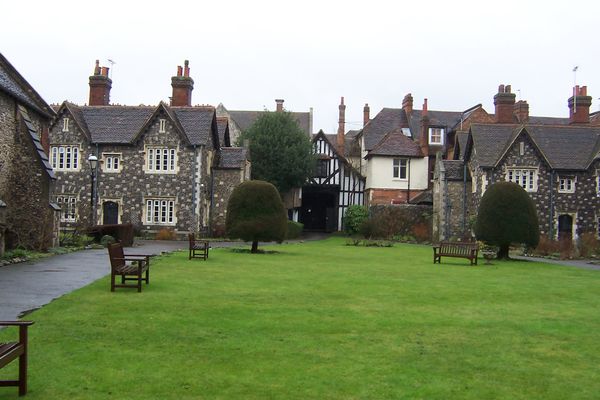
Canterbury In continuous use
as homes for the elderly
since the time of Lanfranc
the 1st Norman Archbishop.
Sheila Sweetinburgh’s talk about the brothers and sisters [inmates of EK medieval hospital] was fascinating; she also went above and beyond by giving her talk without slides as we were unable to get to our projector on the night. Sheila said that we were fortunate in East Kent because our records were more complete than many other counties, with some from the early 1400s.
Medieval hospital founders were caring for the souls of their inhabitants rather that their bodies. East Kent had about 70 medieval hospitals altogether; there were none in Deal but most were situated around the coastal strip and along Watling Street. Most hospitals accommodated 12 brothers and sisters and demand for places exceeded supply. The catchment area for these hospitals was extensive and could be beyond Kent.
The two largest medieval hospitals in East Kent were St. John’s, Canterbury and St. Nicholas, Harbledown; each had 30 brothers and 30 sisters but these two institutions were unusual.
The selection criteria for giving a place to brothers or sisters included gender, life cycle, relative poverty, age, health and domicile. Sisters were very much in a minority in Kent’s hospitals and some institutions were exclusively male, including Maison Dieu in Dover and Ospringe and the Poor Priests’ hospital in Canterbury.
Sometimes an elderly couple would enter a hospital together as a brother and sister or, more commonly, a husband would enter first while his wife remained outside and she may have only entered later as a widow. Brothers and sisters were rarely, if ever, destitute; a fee was needed for entry into the hospital and higher status hospitals demanded higher fees. Also your good reputation was important. Age was not mentioned in hospital statutes although sisters at St. Thomas’ Canterbury had to be elderly (over 40 years old!) to look after the pilgrims. Health-wise, you needed to be fit enough to work on the hospital’s behalf and if your health deteriorated, you were not guaranteed to remain there until you died.
Being a brother or sister, your life was spent in prayer and you needed to know the Paternoster and Ave Marias in Latin. You also took a vow of chastity and a vow of obedience to authority. Brothers and sisters also cared for the sick, pilgrims and for their fellow brothers and sisters in the hospital. Work took place in the brewhouse, bakehouse and kitchens, in the dairy, looking after animals, haymaking and growing fruit and vegetables.
The diet and standard of living in medieval hospitals was probably better than outside but there was not a complete cut-off between inside and outside. Married couples often had one partner who was a brother or sister, while the other partner lived outside in the community for at least part of their married life. Their burials were also looked after and brothers and sisters were remembered in prayer rolls after their deaths.
Sheila gave us individual examples from the medieval records at particular institutions from her research. This talk opened a window onto an area of history many of us knew little about and gave an insight into medieval life and medieval hospitals in East Kent.
Report by: Lesley Smith, Secretary of Deal & District Branch,Kent FHS