
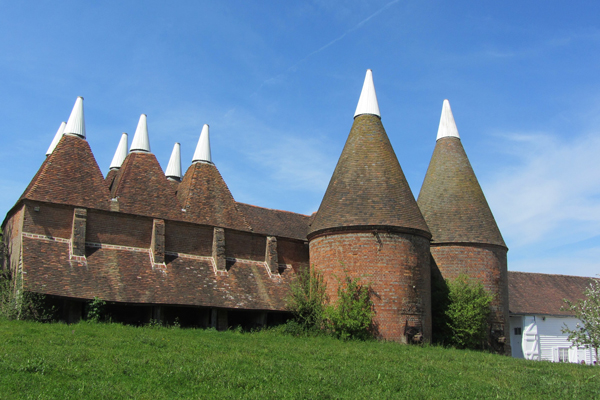
Sue gave a very informative talk packed full of detail, which was of great interest to all, even those not having ancestors who went Hopping down in Kent. It provoked a lively discussion at the end of the talk with some members recalling their own time as Hoppers and others recounting family tales.
She started with the origins of hops in England which were first added to Ale in Saxon times as a way of improving the flavour and fragrance. She then posed a rhetorical question: Why is Kent particularly associated with hops? As several other counties such as East Sussex, Hereford, Worcester and NE Hampshire all grew them? In answering her own question she suggested it may have been the enclosed field system in Kent, good soil with a plentiful supply of wood, plus Kent’s close proximity to the London markets. In the 15th century Flemish brewers settling in the county produced Beer which was much preferred to Ales but also required a good supply of hops to produce.
It is thought that the first Hop Gardens in the country started in Kent during the 1520s at Westbere, East Ashford and Little Chart. Although, at one time 14 counties were growing hops, Kent grew a third of the entire national crop, and continues to do so.
Sue showed photos of Brook Museum which has a row of Hoppers Huts and the various hopping implements on display. She explained that stilts were needed in order to tie the hop bines to their supporting frames which were 25ft high. This work was carried out by stilt men on 13ft high stilts. They needed a ladder to climb on to their stilts.
She also explained the workings of the Oast Houses that dried hops. At first they built square Oast Houses but then John Reid invented a circular Oast House which was considered a more efficient design for drying the crop. Sue said that nowadays only a few Oast Houses remain for their original purpose as many have been converted into housing.
When compulsory schooling started in the 1880s the school year was arranged around the hop harvest. But the short picking season, just 6 weeks, coupled with an increased demand for hops made it impossible for Farmers to find enough local people to harvest the crop as the work was very labour intensive requiring hundreds of pickers.
For many Londoners from the East End hopping down in Kent was the only chance for an annual holiday. First the regular pickers waited for a letter from the Farmer to say when they could go and sometimes enclosing rail tickets with the letter. Others waited for a town crier who called out dates, place and times to catch one of the buses assigned to take them to the Hop Gardens. Whilst others might go by bike or even walk there. Many would get a doctors sick note so they could get time off from their regular job to be hoppers.
The women of the family would pack items to make their tin huts homely such as curtains, oil lamps, candles and crockery, plus food such as dried and tinned. Whilst the men of the family would often set out a few days in advance of their families to burn off the bugs and paint and decorate the hut in which they would live during their working holiday. The huts were often decorated with offcuts of wallpaper with each wall decorated in a different pattern. Each hut although small had to house everyone in the family and living conditions were very basic with communal toilets and washing facilities. However, as Sue pointed out, for many this was hardly any different to the way they lived at home.
The working day started at 7am until 5pm with an hour for lunch. The children were very excited as for many it was the only time they got to see the countryside, fields and cows. Children were expected to start the day by picking a set amount of hops and then they were excused to go off and play for the rest of the day. A whistle was blown about half an hour before the end of the working day as a signal for the pickers to complete the basket they were working on.
A record of how much each person picked was kept by a Tallyman who ensured the bins were full and recorded it in a book. The Hoppers were given a receipt by way of a token, tally card or a stick which was marked off and kept by them. They were paid at the end of the season. It was a complaint that they never knew what their exact earnings would be until the end of the season. Some saved their wages whilst others had nothing to show at the end of the season as they had drunk it all way on the tab in the local Pubs. Not only pubs but there was a lively social life for the families after work.
Although, Hopping continued into the 1950/60s there were protests in 1908 about foreign imports of hops. Whilst in 1934 mechanical pickers were introduced much to the alarm of the Hoppers. At first contests were organised between the hand pickers and the machines and hand pickers could often win. But as machines became more sophisticated it only needed 3 or 4 men and a machine to pick the harvest. Sue said all through the war hoppers continued to come down to work picking hops even whilst planes were fighting overhead. One group of Hoppers even captured a German pilot who had been shot down. He had his hand on his pistol until he saw how many Hoppers there were and sensibly gave himself up to them whilst waiting for the authorities to take him into custody.
Sue ended by saying that although the amount of hops grown has fallen significantly there is still around 2,600 acres in use as hop gardens each year and Kent is still the prime producer. If you want to see a Hop Garden Sue suggested to look in the fields as you pass Brenley Corner where the M2 starts or visit one of the many Museums in the County.
About the Speaker: Sue Duckworth loves to share her passion for local history with others by telling the tales, both fact and fiction, about the region she lives in. She worked for almost 20 years as a Librarian in Kent and, since 2012, as a professional Blue Badge Guide for the South/South East of England, Canterbury Cathedral and a Green Badge Guide for the City of Canterbury.
Report by: Tricia Baxter