
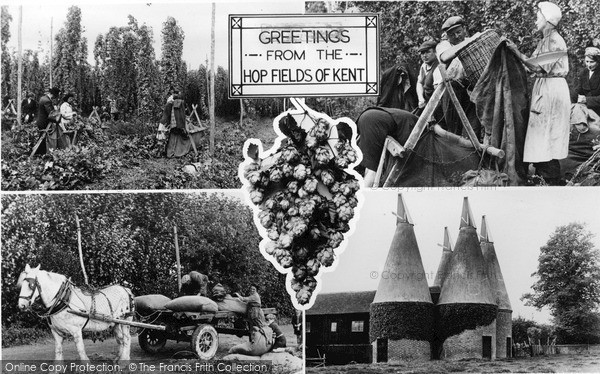
This evenings joint presentation was started by Richard Bones who, as a former Hop Farmer, talked about Hop growing and the Hop Pickers. Richard said he took over responsibility for Homestall Farm, off Brenley Roundabout, when quite young, as his parents had died. At Homestall Farm they grew Apples and Cherries although the Hop garden was the main product.
Richard showed photos of the farm and the sheds that housed the Hop pickers during their working holiday. Pickers were mostly from London although, local people were also employed but they could go home at the end of the day. There were 100 Hopper’s sheds, and each could sleep about five despite being only 8‘x8’. Whole families of Hoppers slept in them during the weeks they spent in Kent this made the casual workforce somewhere in the region of 500 at Homestall Farm. Every member of the family helped pick from children to seniors. But since the mechanisation of the picking process from about the 1950s fewer pickers are needed and those that come now are now housed in about a dozen caravans. Richard also showed two huts which housed 2 Nurses who saw to all the Hoppers medical needs.
Richard talked about the history of Hop Picking and said that Homestall Farm had been a farm since the 1590s. His family owned it from WWII until he retired a few years ago. The Romans grew hops but they ate it like asparagus. Hops were grown in Flanders in 1520s and the Flemings brought it to England in the late 16th century. The first Hop garden in Kent is thought to have been in Westbere in 1620.
In the time of Henry VIII there was a dispute between Ale and Beer producers and the use of Hops. Berries had been used to enhance the flavour but to keep the beer longer bacteria needed to be kept down and Hops were used to sterilise the beer as well as improving the flavour.
At first Hops were dried in round Oast Houses but through the years it was found that square houses were better. At first wood fires were used to dry the hops in the Oast but it was soon realised that charcoal was far better as it could reach higher heat.
Preparation of the Hop garden starts in the Winter with cutting back the old plants and building frames and stringing them. This can be done by hand with a long tool to add the string (made from coconut fibre) to the top of the frames. This was also done by stilt walkers.
Hops have a male and female plants. Less males plants are kept as they can stop the female producing the part needed in beer production. Hops are grown in clumps called hills, in the Spring the best 3 plants are selected from each hill to wind around the string. Hops follow the sun so it is important to wind them so they can follow the sun or they will unwind themselves! Hops are also best grown slantwise. They are prone to mildew, aphids, red spiders, wilt, damage from wind etc and the gardens needs to be well drained so the farmer needs to be on the lookout for crop damage. But on one hot night with rain Richard recorded a growth of 6 inches!
In the Autumn when the Hops are ready to be picked Richard showed us the Tally sticks that the Tally man would use to count the number of baskets each picker filled. They would cut the tally in half one part kept by the Tally man and the other by the picker. when counting each day the Tallyman held his part and the pickers part of the tally together and marked them both so no one could adjust the number of baskets each picker had picked. Pickers were paid per basket. The pay was often used to buy clothes and shoes for the children. Unfortunately, for some families, they never took home any pay as they, or the father, drunk the equivalent of the pay in the local pub!
Geoff Doel took the floor for the second part of the presentation. He introduced each song by talking about the history and where the song had started from. One was a melancholy song about a group of pickers riding in a waggon over a bridge when the horse shied and they all fell in the river and 30 died. He said today every year the traveller community come to recall the disaster and sing the song. Geoff ended by singing the ditty after which Geoff and Richard’s presentation was named: “Hopping down in Kent!"
About the Speakers
Richard Bones is a former Hop Farmer who has experienced hop picking from boy to man and by both hand and machine.
Dr Geoff Doel has thirty years’ experience of researching and lecturing on folklore for the universities of Kent & Sussex, Birkbeck and Goldsmiths Colleges and the City Lit. He has a PhD on Thomas Hardy and alongside Fran Doel MA, has lectured extensively in adult education at various universities on literature, medieval and traditional culture. Together, Geoff and Fran are the authors of several books on aspects of traditional British Culture, including Worlds of Arthur, Robin Hood, and A Dorset Christmas all published by The History Press.
Report by Tricia Baxter,
Hon. President of the Canterbury Branch of Kent FHS.