
Ian Everest began the meeting by telling us that he comes from a family of farm-workers and that he attended Plumpton Agricultural College in the 1960s. As a teenager he was not interested in WW1 but in 1982 an evening class teacher decided to research family history – and he was ‘hooked’, and has been from then. Ian found many records about the Everest family. One, A F Everest, was killed on 3d September 1917 and he showed us a slide of trench maps and where this member of his family was killed. After visiting his grave Ian wanted to find out as much as he could about WWI.
When his grandmother died his grandfather came to live with the family. In 1904 his grandfather joined the Middlesex Regiment and on 23rd August 1914 he was sent to Boulogne, France with the British Expeditionary Force. Although at that time they outnumbered the Germans his grandfather was taken prisoner on the 1st day. His family thought that he was missing but he arrived home unexpectedly. Ian showed us a slide of the cemetery at Mons where there are 324 British and 284 German graves and continued to give us an illustrated tour of the British and Commonwealth sectors of the old front line. Using period and contemporary photographs he showed how the Western Front looked during the war and what the visitor can now expect to see on a visit to the area.
Around Belgium we were shown various slides of the memorials and cemeteries.
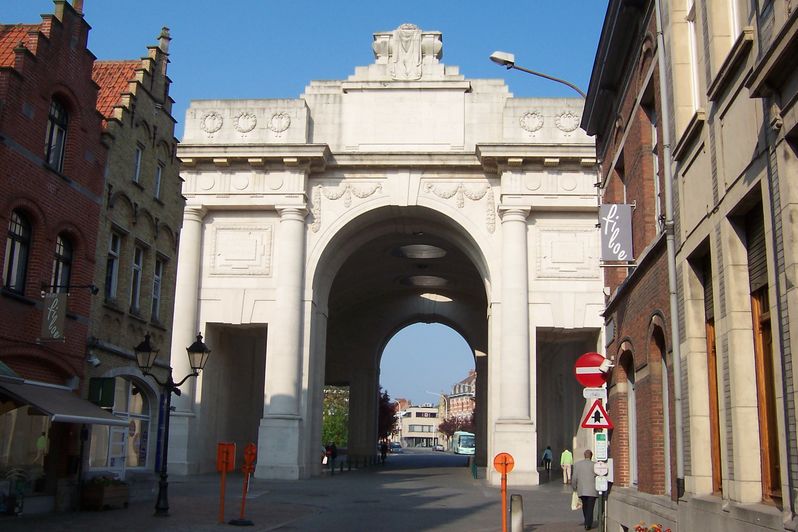
We were shown Ypres and how it looked in the middle ages when there was a cloth industry amongst other businesses. We were then shown a slide of how it looked after it was bombed, plus the history of the town before the Menin Gate was built. The town was been rebuilt and The Menin Gate was constructed in memory of the unknown soldiers. It was started in 1921 and finished in 1927. There are 55,000 names on the walls and along the walks. At 8 pm every night the traffic is stopped and bugles are played by the local Belgium Fire Brigade.
In Flanders it was difficult to dig trenches because the land was often flooded. A slide showed us a map of the area and the many trenches.
At Essex Farm, where a Canadian Surgeon wrote the poem ‘In Flanders Fields, the wounded were given first aid and then brought back to Folkestone, England.
At Lijssenthoek there was a ‘dressing station’. Most of those buried there were identified. The Military cemetery shows how many were killed there.
Poperinge where 360 were shot for desertion. In the town is Talbot House, known as Toc H. It was established by the Reverend 'Tubby' Clayton in December 1915 as an 'Everyman's Club' for soldiers and officers of the British Army. It is now a 'living museum' and also offers self-catering accommodation for individuals and small groups.
Passendale. We were shown a slide before the war and afterwards of the original cemetery.
Tyncott. Here only 3800 of the buried were identified. Thousands were not known.
In France we were shown a slide of the Arras cemetery and Memorial and also one of the ruins of a bombed church. Then shown a view of the German held land
At nearby Vimy Ridge there is a Canadian Memorial. It stands as a tribute to all who served their country in battle and risked or gave their lives in those four years. The Canadian success here demonstrated that no position was invulnerable to a meticulously planned and conducted assault. This success had a profound effect on Allied planning. There were 3,598 dead out of 10,602 Canadian casualties.
Along the Somme, that is now farming land, there are many cemeteries as several battles were fought there. The Sheffield Memorial Park is dedicated to the memory of all members of the Accrington Pals, the 11th (Service) Battalion East Lancashire Regiment, who fought and fell in this location in the opening phase of the Battle of the Somme. Many of those who died were employed in brick work companies.
Visits to the battlefields began a year after the war ended.
This was Ian’s first visit to Kent and Canterbury Branch to give his talk which was extremely interesting.
Report by Sandra Marvin