
Doreen started her talk with a statement and a question: On Saturday 25th December, Christmas Day 1647, the so-called Plum Pudding Riots broke out in Canterbury and two days later people from the surrounding villages stormed the city gates to join in the demonstrations. Why did they protest?
Doreen set the scene by describing events leading up to 1647. She started with the marriage of Charles I and Henrietta Maria, the King of France’s sister, which took place just after Charles succeeded to the throne in 1625. They married by proxy before the bride left France. Her arrival in Canterbury, where the wedding night was to be spent, was delayed for two weeks due to bad weather in the Channel. During Charles’ wait for his bride Sir John Finch, Recorder of the city and one of its two MPs was knighted by the king and a sermon was preached by Isaac Bargrave Dean of Canterbury supporting the King’s rule. Bargrave told his congregation that it was the duty of a subject to support the king. But other clergy voiced the conflicting opinion that it was a subject’s duty to resist any lawless commands. Charles, strongly believed in the divine right of kings and when he spoke it was as if from God.
The king believed he alone should be governing the country and if he didn’t like proposals by the House of Commons, he simply dissolved the session. In 1629 the king wanted to prevent a resolution being passed. Sir John Finch, was Speaker of the house and it was the speaker who official dissolved parliament. Finch was held down in his chair by MPs so he could not dissolve the session. The King was so incensed, that he would not call Parliament for 11 years. During this period the king had difficulties financing his projects as only parliament could grant funds. Hence, Charles needed to get money in other ways.
Ship money was a tax that towns were required to pay, to provide ships for a navy in times of emergency. But the king started demanding the tax when it wasn’t a time of emergency. Ship money was £415/9s/6d in 1635 and £323/17s/6d in 1636, (in excess of £78,000 pa today).
Another issue was the Book of Sport. The king authorised that certain games could be played on Sundays and in 1633 ordered the Book of Sport to be read out from every church pulpit in the land. After which the congregation were expected to go and play the permitted sports. This was against the Puritans’ thoughts about the Sabbath which they felt in a Godly society should be kept holy, and it was not only the Puritans who thought that way. The Reverend Richard Culmer of Harbledown was amongst those who strongly objected to sports being played on Sundays.
Doreen talked about the religious turmoil when William Laud, became Archbishop of Canterbury. He wanted to restore the order and dignity to the church and ordered rails to be placed around communion tables trying to restore the beauty of holiness. Others such as William Somner of Canterbury thought things were going too far. On top of which, Charles I’s Queen, was Catholic and known to regularly celebrate mass. Memories of Foxes Book of Martyrs and the burning of Protestants at the stake were all too recent in people’s memories and they feared the return of the Church of Rome to the country. Catholicism being considered a false and cruel faith. So great was that fear that 21,000 people left England at that time and 40 of that number were from Canterbury.
Doreen showed documents about four Canterbury men: Thomas Starr, Joseph Butcher, Sam Hall and Edward Johnson who were amongst the 40 who decided to leave the country at that time. She said the fear must have been very real to them or why would Edward consider uprooting his wife Susan, their 3 servants and 7 children, aged from 2 – 14 years, to endure a 6 weeks sea crossing to live in unknown territory in North America. But for the majority of the population, they had no option but to remain in the country.
At this time Charles was at war with his Scottish subjects and this forced him to call parliament for the first time in 11 years as he needed to fund the war. But MPs refused to grant funds unless the king listened to them.
This was the start of the Civil War. Doreen said that today we tend to think of places being either Royalist or Parliamentarian but she said it was not as simple as that because there was a wide spectrum of views in the country with people often changing sides. During this period Parliamentary soldiers were sent to Kent and caused damage, to the Deanery and the cathedral in Canterbury. The window in the North West Transept which depicted St Thomas was destroyed with the declaration that they were “rattling down proud Becket’s glassy bones”. Crosses and statues in the cathedral and on Christchurch Gate were also damaged or destroyed.
Parliament banned the Book of Common prayer and ordered burials without rites as they are not mentioned in the bible and there was to be no signing of the cross at the baptism of a child as it was considered witchcraft. Doreen said how much this was taken up and how many clergymen continued saying the rites from memory is unknown.
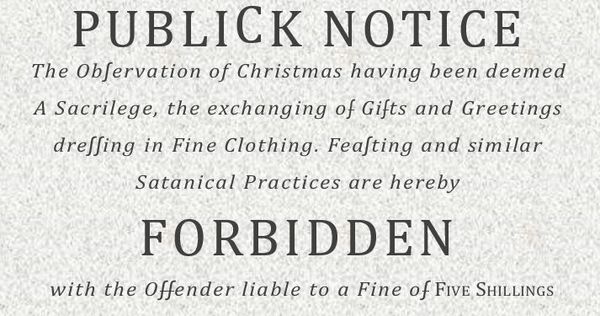
Parliament’s attempts to ban Christmas celebrations people felt was most serious. Festival Days were not mentioned in the bible so they were not the word of God and considered by the Puritans to be a Catholic institution. But many Canterbury citizens disobeyed the order to treat Christmas as if it was a normal day. “For God, King Charles and Kent” declared the protestors who wanted to celebrate the nativity of Christ and wanted the return of the king. Citizens had originally wanted the king removed but now found that parliament was just as bad.
Eventually the rioters were arrested with those who were citizens of Canterbury imprisoned in the Westgate. Whilst those from the surrounding towns and villages were held in the Castle. Canterbury citizens were tried in the Guildhall, which was then on the corner of the High Street and Guildhall Street and the jury returned a verdict of ‘ignoramus’ which meant they could not be punished. Quickly a message was sent to alert the Jury at the trial of the villagers, which was being held simultaneously just 5 mins away and they returned the same verdict.
This sparked the second Civil War which fanned out through Kent with a bloody battle at Maidstone on 1st June 1648. Eventually Sir Thomas Fairfax arrived in Canterbury and ordered part of the city’s western walls to be taken down so that the citizens could not lock themselves inside their walled city.
King Charles was offered the chance to return but kept prevaricating. Eventually, on 29th January 1649, he was executed.
Report by Tricia Baxter
Speakers Secretary for Kent FHS