
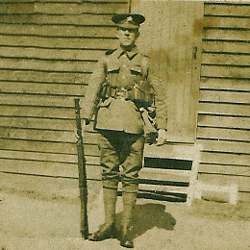
In this very informative talk, covering the period 1850 to 1920, Paul Nixon started by advising us to question everything in the photograph. Although, there are many clues
The Jacket pattern, the trousers and the stripe on them, if there is one, cloth badges, collar badges, hat style accoutrements and the facings (cuffs and collar) colour all give clues.
The cuffs on the jacket give a good clue as to the date. If they are straight (Jam pot Cuffs) it is almost certainly pre 1902 when they changed to pointed ones.
The Royal regiments have blue facings, English and Welsh regiments have white, Scottish ones yellow and Irish, other than the royal ones, have green. The rifle Brigade had green and black and the Kings Royal Corps had green and scarlet
A thick trouser stripe denotes an artillery regiment or engineers. All others have thin stripes.
The Good Conduct Chevrons are a good indication of service length, the first one was obtained at 2 years and the others at set times, although different regiments varied.
The Slade Wallis belt buckle colour varied, silver attachments and gold centre denoted Militia , gold silver regular soldiers and all silver were volunteers.
The crown on badges can help dating as well because they changed with the monarch. If the monarch was a King the crown was more domelike whereas that for a Queen.
If you have a photo with a totally plain uniform that is a Prisoner of war. Paul cited a case where he had one that was a postcard. By using the address he was able to find them in the 1911 census, There were 3 sons but by looking at the POW index was able to work out which son was the prisoner.
If you have a Scottish Soldier ancestor and he is wearing a kilt he was either in a Highland regiment or a bandsman, the sporran and its top (the temple) can be a very good guide as well.
Should you be lucky enough to have a football team photo, the Regiment and date are usually on the ball. They usually stand in the photo in the position they play, for instance the goalkeeper is usually centre of the back row, so if you can then find a team list that can help identify who was who.
Paul finished by stressing how helpful Facebook groups can be, 2 good ones are
British Army and Navy 1888-1914 and Soldiersofthequeen
And, Paul recommended the following websites:
Guards, how to distinguish which regiment: Guards Division
Soldiers of the Queen https://www.soldiersofthequeen.com/.
Uniformology http://www.uniformology.com/
Paul’s own website https://www.britisharmyancestors.co.uk/
-----------------------------------------------------------------------------
Report by
Sheila Harris