
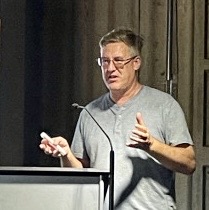
Andrew started by saying it was a challenge to cover several thousands of years in the space of one hour! He then went on to describe the bigger picture.
There have been 900,000 years of human activity in the British Isles with the earliest traces of human beings found in Norfolk. The traditional image has always been a linear progression from apes to modern man, however DNA has shown it to be far more complex. The University of Wisconsin has developed a tree based on recent findings showing that there are various branches of early man (many more than was originally thought) developing in different ways. There is little or no DNA available for very early humans although modern methods may soon improve on this. But there is evidence of significant interbreeding between Neanderthals and other human species, which means that today almost all Europeans carry some Neanderthal Genes. Whereas at one stage it was believed that Neanderthals were very primitive it is now recognised that they were more sophisticated than at first thought, and very well adapted to the cold of the Ice Age.
Cheddar man was living 8,000 years ago, and was one of the first of our British ancestors that archaeologists were able test. His DNA shows that he was dark skinned with dark hair but that he had blue eyes and it is only in later times that blue eyes have been paired with pale skinned blondes.
Farming spread into Britain about 4,000BC when we were still attached to mainland Euope and DNA shows that it was largely migrants that brought this knowledge to our Hunter Gatherer Ancestors. Through the next centuries migration continued and interbreeding occurred, for this reason 90% of British people have the same markers in their DNA.
In more modern times the Roman army brought a greater diversity to our shores although, Kentish people have more genetic links with the French as might be expected. The arrival of the Angles brought more changes, initially it was thought that this was due to assimilation but it is now recognised that migration played a larger part. Genetic markers from people in Denmark, South Scandinavia and Germany were absent before this period.
Andrew stated that a Viking, is not actually a nationality but a culture and our Viking ancestors had the same DNA as Anglo Saxons. People from western Britain have less Anglo Saxon DNA than those from other parts of the British Isles.
There are many Anglo Saxon cemeteries in Kent and East Anglia, the largest of all is at Buckland in Dover. By testing the DNA of these skeletons it was possible to form family groups even though they were not always buried near one another. One surprise was that a young girl in Eastry cemetery was shown to have had a Nigerian grandfather.
Andrew showed how his own ethnicity had differed depending on which company carried out the test although their totals will be much the same the focus for one company may be slightly different to another. Andrew therefore suggested it could be useful for us to do tests from at least two companies as a comparison.
Andrew rounded up his talk with the fact that because of population limitations by 1,000 AD all European trees had intersected and we can all say we are descended from Charlemagne!
Report by Sheila Harris