
Anthony Marr gave a fascinating talk about a subject close to his heart, having spent a long career in the Met Police until retirement, and fortunately for us, a professional genealogist for ten years.
He spoke about the records that our legal system has created over the centuries and how they can be accessed by genealogists today, be they records of the police, of cases heard in courts, archives of the Home Office, from newspaper reports and prisoner release papers. Anthony assured us that all our ancestors appear in these records, on one side of the law or the other!
The court system developed to dispense the reigning monarch’s justice upheld originally by Sheriffs, the Sheriff of Nottingham perhaps the best known. The system was hierarchical and was primarily run by and for property owners. Justices of the Peace sat in judgement locally, and would sit together regularly as a Petty Sessions Court (today’s Magistrate Court) for minor offences. For more serious crimes the cases would be heard at a Quarter Sessions Court (i.e. Magistrate’s Court), held four times a year, whilst the most serious cases were passed up to the Assizes, presided over by visiting judges twice a year.
Petty Sessions records can be found in County Record Offices (CROs), but are rarely indexed and their survival rate is variable, though Kent History and Library Centre hold transcribed and indexed records of Petty Sessions; as do Canterbury Cathedral Archives who have some years searchable online. The records of the Quarter Sessions look more like a court as we know it and they can also be found in CROs. Start with the Gibson Guide to see what still exists. Some records are already online and are growing in number.
It may be better to start with newspapers with the British Newspaper Archive which is digitising their immense holdings from the 1700s onwards. The British Library has specialist reading rooms in London and Boston Spa. Findmypast also gives access to the same database as part of their subscription, but with an inferior search engine. Ancestry has only a few newspaper records. CROs mostly hold copies of local newspapers on microfilm. Local libraries can also be a good source.
Anthony recommended Ancestry’s record set: England & Wales, Criminal Registers, 1791-1892 which contains returns to the Home Office of persons charged, based on TNA’s holdings at Kew (ref. HO27). FamilySearch’s Calendar of Prisoners is a copy of local records of the ones sent to the Home Office (TNA: HO 140, and CRIM 9 for London). By digging down in the records you might find depositions made by witnesses. Findmypast also has criminal records in their series England and Wales, Crimes, Prisons & Punishment 1770-1935, but Anthony felt they are playing catch up.
Surviving records of the Assizes are held at TNA, including minute books, indictments and depositions. They are a very underused resource. Some records covering expenses or minute books may be held locally. The Assizes in London was the Central Criminal Court, known also as the Old Bailey. The latter are collected in the CRIM series at TNA, e.g. Old Bailey Depositions are in CRIM 1/43/9. Records of the Old Bailey from 1674 to 1913 are online at www.oldbaileyonline.org.
The ultimate sentence handed to a guilty person for a whole range of crimes was to be hanged, for many years in a public place, until protests lead them to be carried out in the prisons which were being newly built in the mid 19th century. The “lucky ones” endured hard labour in prison, often to no useful purpose such as the treadmill or the crank. Transportation began as a method for getting rid of criminals in the 17th century and continued into the second half of the 19th century, firstly to West Africa, then the West Indies, the American colonies and lastly Australia from 1758, peaking in the early 19th century. Many though never went and ended up on offshore prison hulks where life could be cut short by disease. The Digital Panopticon www.digitalpanopticon.org is a source for tracing London convicts in Britain and Australia between 1780 and 1925.
Hulk registers can be found on Ancestry and FMP. Records for Pentonville prison are at TNA in series HO24, and letters requesting clemency in HO 17, 18 & 19. Licences for early release of prisoners can be found at PCOM 3 & 4. Later licences are very detailed and may contain a photo. Beware that prisoners were moved around between jails. CROs hold prison records. Prison staff can be found on census returns and records of prison officers such as Appointment Books and pensions can be found either in Home Office records or CROs for local prisons.
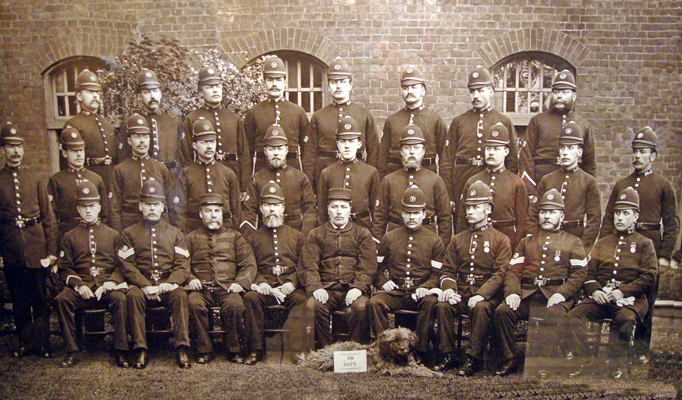
Policing began at parish level where each parish appointed a constable on an annual basis, but was an unpaid post. Appointment may be found in Overseers Accounts in the parish chest. As towns grew they employed watchmen to keep order. In 1829 the Met Police (records in MEPO series at TNA) were formed and in 1856 all boroughs were required to have police. The City of London Police records can be found at the London Metropolitan Archives, whilst some forces have an archivist and/or museum.
Our Criminal Ancestors ourcriminalancestors.org is a project led by the University of Hull in collaboration with Leeds Beckett University, which encourages and supports people and communities to explore the criminal past of their own families, communities, towns and regions.
Useful books:
Criminal Ancestors by David Hawkins
Tracing Your Criminal Ancestors by Stephen Wade
Police Museums and Archives:
The Kent Police Museum, formerly at Chatham, moved to Faversham in April 2022.
The Met Police Heritage Centre is currently closed and will be moving to Greenwich.
Report by Chris King