
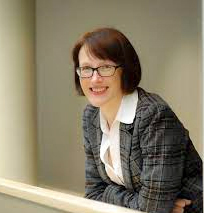
Our speaker, Rebecca Probert, is a Professor of Law with a particular interest in family law and legal history. She has written on all aspects of modern family law, but the focus of her research is the history and laws of marriage, cohabitation, bigamy, and divorce.
Rebecca started by dividing the period 1700 – 1900 into three phases and listing law and practice under Mandatory and Directory headings and posed the questions: How could couples marry? - Where did they marry? - And, how likely is it that a record of the marriage has survived? Rebecca showed graphs of several parishes she had investigated in her research.
1700 to 24 March 1754 – marriage was governed by cannon law.
Mandatory – The marriage was not legal unless: There was free consent of both bride and groom. And, the ceremony had to be performed by an Anglican Minister.
Directory – there were possible consequences if not followed but it did not affect the validity:
Parental consent if under age at marriage. - By Licence or Banns. – To take place in the parish church of residence of one of the participants and recorded in the parish registers.
Finding where marriages were performed pre 1754 is reliant on parish records remaining or the marriage having being recorded in the first place. Such as the failure of the Vicar to keep up the registers. There is some evidence of non-Anglican marriages in this period, mainly Catholic, where dual ceremonies had to take place. Rebecca said the validity of such marriages was dubious, as was the legality of Quaker marriages. For other non-Anglican marriages; there were virtually none before 1754 and if there had been they would not have been legal.
25 March 1754 – 30 June 1837 – After 1754 the possibility of non-Anglican marriages was being explored. Jewish marriages had not been expected to follow canon law as they were considered legally to be aliens and following Jewish Law. Quakers were also exempt. However, Catholics still needed to undergo dual ceremonies; first a Catholic marriage which they considered the real marriage and then, on the same day or shortly afterwards, a second Anglican marriage took place. Other Protestant non-conformists, although they could register births and deaths, were still required to conform to cannon law for their marriages to be recognised as legal.
Before 1753 and the Clandestine Marriages Act some Anglican clergy were not asking too many questions from those asking to be married and London and the Fleet Prison were the Las Vegas of their era with a very high number of clandestine marriages taking place. Lord Hardwick brought before Parliament the need to bring marriages back under canon law and make illegal those marriages that did not adhere to the law. Hence from 25th March 1754 to 30 October 1823 a marriage was invalid if it did not comply with the conditions of the 1753 Act. It was still mandatory that it had to be performed by an Anglican Minister with consent of both bride and groom. These two regulations were now joined by the requirement that the marriage had to be by Banns or licence with parental consent obligatory for those under 21 if married by licence. And, that the ceremony was to take place in a church or chapel. Marriage Act 1823 – after 1 November 1823 a marriage was only invalid if the couple had ‘knowingly and wilfully’ flouted the law as laid out in the 1753 Act.
1 July 1837 – Marriage Act 1836 – allowed for register office or civil marriages which, until 1857, could have religious elements in the ceremony. Non-Anglican religious marriages could take place in a registered legal place of worship as long as this was a separate building. It did not matter if you were of a different denomination as long as the place of worship was legally registered for marriages. Jewish and Quaker marriages were regulated more than previously being brought under the legal structure of the Act.
Rebecca rounded off her extremely informative talk by mentioning the implications for Family Historians. She suggested that church registers should be the first document to check as it is more likely that a marriage had taken place in a church; despite the 1836 Act appearing to give people more freedom.
Those of you who attended this talk may be interested to read Rebecca's paper on the subject of bigamy.
https://www.qualifiedgenealogists.org/ojs/index.php/JGFH/article/view/120
Report by Tricia Baxter