
A recording of this talk was broadcast on 2nd February 2021.
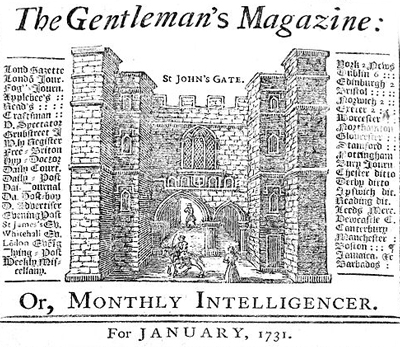
This evening’s speaker, Julian Pooley, was the Public Services and Engagement Manager at Surrey History Centre. The subject of his talk is the project he is currently working on; extracting details relating to Surrey from the Surrey County Archives collection of the Gentleman’s Magazine. He said he had come across several items relating to Kent to include in this evening’s talk as the Magazine did not just cover Surrey as there is good coverage across most English counties.
The 18th century was swamped by printed matter, newspapers, periodicals, chapbooks, etc. so much so that no one could possibly read them all. The Gentlemen’s Magazine was an attempt to make a digest from all the printed matter in circulation at that time. It was in production from 1731 to 1868 and the Biographies published within its pages, often of quite ordinary people, were said to have been the inspiration for the Oxford Dictionary of National Biography.
Founded by Edward Cave (1691-1754), who was the first editor, it covered a plethora of matters. It published articles, quite diverse, of both Domestic and Foreign affairs, Births Marriages and Deaths, Crop Prices, Civil and Ecclesiastical Appointment, Bankrupts, Poetry, Parliamentary Debates, Book Reviews etc. Plus letters to the editor; who, from Edward Cave, always went by the pen name Sylvanus Urban, Gent. The Magazine did not carry advertisements within its pages but printed them on the wrappers. Regrettably, few wrappers have survived due to being discarded when the issues were bound together for personal libraries. But those that have survived are invaluable sources of information in themselves.
Julian said that although from its title it appeared to be aimed at men in fact many ladies were avid readers too.
It was so successful because it was so inclusive of such a variety of things. Because inventor knew they would reach a greater audience, many sent in their original inventions, sometimes weird and strange, but with images and diagrams supplementing them. Julian showed a variety of these, often well thought out inventions, such as The Flying Ship which appeared to be Rocket propelled but had feathers? One supposes in case the rocket failed?
Engraved maps, which were very detailed, were enormously expensive in this era but maps from throughout the world were printed in the Magazine including Maps showing the stages of an eclipse across London, Europe and the rest of the world.
It printed the lurid and sensational accounts of Court Cases and exposés of lawbreaking. Julian gave the instance of the plight of young apprentice girls, who were badly abused behind the scenes. The Magazine including engravings depicting the dreadful ordeals they were going through. Lists of Criminals from Assizes and Quarter Sessions throughout the country were published with details of the crimes and punishments.
Autopsies were reported often explicitly and included detailed engravings of the surgery. Julian showed the report on the autopsy of King George II which included a diagram of his heart. Also details of operations including how to perform them such as a cataract operation and reconstruction of a nose.
Interesting and intriguing are the detailed Health and Medical causes of death stats. Numbers are given by gender and age, with a list of varied causes such as: Croup, French Pox, Killed by a Boar, Scalded, to name but a few.
The Birth, Marriages and Deaths that were printed are useful as sometimes it’s the only place where you will find extra information about people. But Julian said to try and find back up evidence especially in the case of obituaries. The Magazine accepted them from people who had written their own and before they had died. Unfortunately, some were published before the person had died!
This was a most interesting and fascinating talk about a greatly untapped source for the family historian.
Where can you read them? A collection is on open shelf at the British library and many local record offices hold them too. Although, there will be gaps in the issues.
Online: Google Books and the Hathi Trust https://catalog.hathitrust.org/Record/000542092
Report by Tricia Baxter