
Prior to the main talk three breakout rooms had been organised for the half an hour period whilst members were joining the meeting. The break out room meetings were led by:
Malcolm Austin Finding people in the Census,
Tim Emptage Military and Medals
Tricia Baxter Canterbury’s Victorian Petty Session.
Members could stay in the main meeting or select one of the break out rooms until we were all called back for the main talk.
David Burgess, our main speaker, then gave us a well-researched, illustrated talk about his paternal family, who were based in East Kent. His father, came from Kent and met his mother in London. Tragically David’s father died on D-Day (6th June 1944) in Normandy. Nevertheless, David’s mother maintained the bond with his paternal grandparents by visiting them, with David, every summer.
David’s paternal grandfather was William James Burgess, born at Lydd on the Romney Marsh in 1889 and married to Clara Medgett; by 1911 they were living at New Downs Farm in Sandwich. William’s father was Walter James Burgess, a shepherd from Lydd who married Ellen Dowle and thence began David’s interest in the Dowles of Romney Marsh.
The marshes were gradually drained over time as more land was brought into agriculture. David illustrated this with various Maps showing the dramatic changes to the coastline of Kent since the Roman occupation. Old Romney had originally been a port on the River Rother but as the coastline moved eastwards, the port was forced to move too. A new port and settlement named New Romney was established at the coast. But, as David remarked, New Romney is no longer as close to the sea since the coastline continues to move eastward.
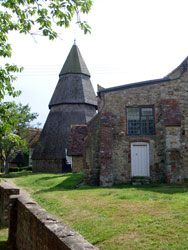
Fourteen medieval churches remain on the marsh and David showed pictures of some that his family had links with. There was also a discussion on the difficulties of life on Romney Marsh; in the early 18th century, life expectancy in marshy areas was 31 whereas it was 43 for non-marsh residents. Hasted described the marsh as ‘sickly and contagious’ and malaria, or ague as it was then known, was endemic on the marsh. David mentioned a particularly low-lying area of swamp lying SE of Appledore, known as The Dowles and wondered whether the family name had originated from there, or if the area had taken its name from the people. Sheep were very important to the economy of the area and many ‘lookers’ kept watch over sheep for absentee landlords. There was a discussion after the talk about shepherds and lookers and what each occupation did. The Marsh was also a hot bed for smuggling and this could be a far more lucrative way of life than agricultural labour.
David traced the Dowle line of his family history back to the late 16th century and shared some of the anecdotes of his ancestors. Henry Lepper, born in 1789, was Ellen Dowle’s great-grandfather and was the Old Town Sergeant of Lydd. When he died in 1883, in his 95th year, he was honoured by having his official cloak, cocked hat and silver mace laid on his coffin. He had been a Town Sergeant for 65 years and the Corporation of Lydd erected a large gravestone to mark his faithful service. In Henry’s will, he left 1/7th of his wealth to his son David and 2/7th to his daughter Elizabeth, possibly because as a widow, she acted as his housekeeper. We also learned of William Waylett, a male midwife, whose immaculate record keeping helped David to verify which Abraham Dowle was his relative; the baptisms register having muddled two families named Dowle.
William Waylett kept manuscript records of all the confinements he had attended between 1757 and 1815 and these records included the name of the mother, location, length of confinement, whether the labour was quick or laborious, sex of the child and how many children he had delivered to each woman and lastly, how much he charged! What a fantastic source of information to find! Other sources are listed below in the Bibliography.
Going further back in his genealogy, David founds links through the female lines to the Mantells of Monks Horton near Sellindge and the Wakes. The Wakes of Liddell made him a distant relative of Joan the Fair Maid of Kent and he quietly agreed that he has royalty in his lineage. David gave us an absorbing talk on the history of the Dowles of Romney Marsh which was truly a trip back in time.
Bibliography
Richard Barham, The Ingoldsby Legends
William Lambarde, Perambulations in Kent
Edward Hastead, The History and Topographical Survey of the County of Kent 1788-1799
T D W Dean, An Historical, Topographical and Descriptive Account of the Weald of Kent (1814)
Thomas Lewin, Invasion of Britain by Julius Caesar Charles Seymour in his “Survey of Kent”
Monumental Inscriptions, Kent Archaeological Society www.kentarchaeology.org.uk/research/monumental-inscriptions
W. Bruce Bannerman, ed., The Visitation of Kent taken in 1574 by Robert Cooke 1574, Harleian Society Publications, Vol. 75 (1924). http://www.medievalgenealogy.org.uk/sources/visitations.shtml
Joseph Jackson Howard, ed., The Visitation of the County of Kent, taken in 1619 by John Philipot (1863) https://archive.org/details/visitationcount00howagoog
Duncan Harrington, ed., The Constables Returns of the Hearth Tax Assessments for 1664 https://www.kentarchaeology.org.uk/sites/default/files/archcant/2002%20122%20Reviews.pdf
William Berry, ed., Pedigrees of Kent
I J Sanders, English Baronies
G E Cokayne, The Complete Peerage of England etc (six volumes)
Sir William Dugdale, The Baronage of England (1676)
Report by Lesley Smith
Secretary Deal & District Branch, Kent FHS