
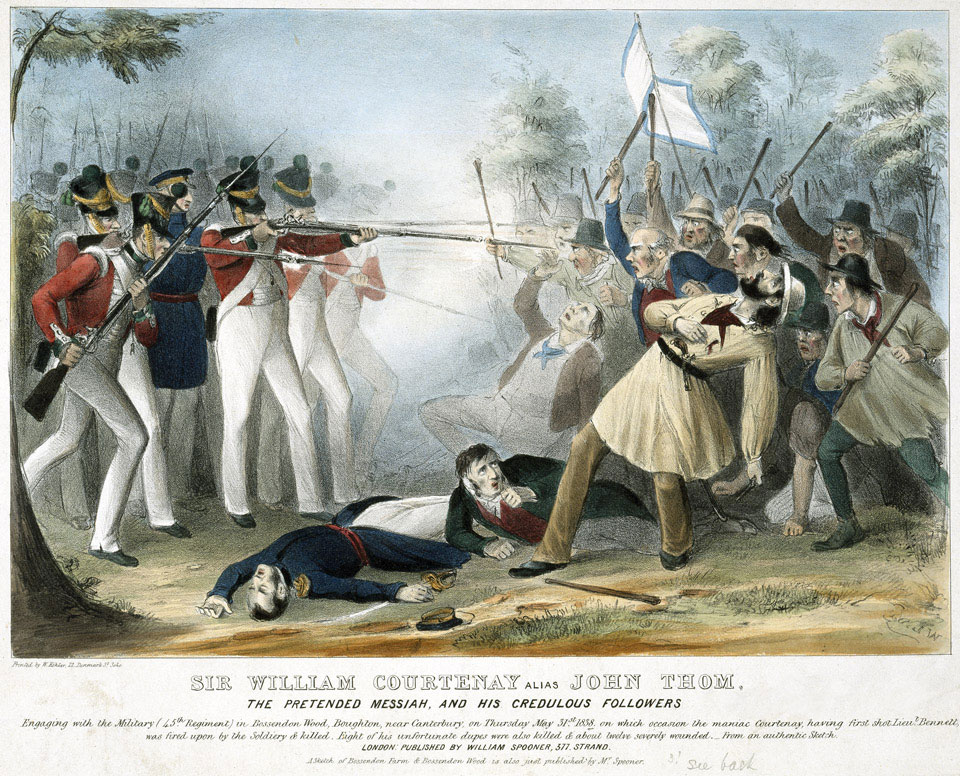
& the death of the rioter's leader Sir William Courtenay alias John Thom
Kent FHS Chairman David Wood’s talk ‘My Ancestors were Revolting.’ was a tale of misfortune about his ancestor’s involvement in the Battle of Bossenden Woods, 1838. David started by setting the scene of the Swing Riots or Agricultural Labourer’s Uprisings of the early 19th century.
In this period of great discontent, a charismatic individual arrived in Canterbury from London. He was physically strong, good looking, a flamboyant dresser and an excellent orator. He called himself, Sir William Percy Honeywood Courtenay, Knight of Malta amongst other, over the top, pseudonyms such as King of Jerusalem and King of the Gipsies. He soon gathered a large following promising to abolish tithes and taxes and make the rich pay. In 1832 he stood as Canterbury’s MP coming 3rd with a good percentage, but only managed 4 votes in total when standing for the County.
He was imprisoned in the city’s Westgate for fraud, causing a riot by citizens who wanted him released. He also spent time in Maidstone Prison awaiting transportation for telling lies! David said, and that should have been the end of the story! But before Courtenay was transported he was identified by his wife as John Thom a Spirit Manufacturer from Cornwall.
Thom had episodes of madness and periods of admittance to mental asylums. He was admitted to the County Lunatic Asylum at Barming for, amongst several reasons, an obsession with cricket! Although, oddly, he was allowed to play in the Asylum’s cricket team! He was well behaved at Barming and released into the custody of his father, who was not a well man at the time.
David then set the scene locally. Dunkirk was extra parochial at this time, and Bossenden Woods was known locally as a haven for those hiding from the law who would set up makeshift dwellings in the Woods. He then introduced us to the locals including his 4 x Great-grandparents John and Lydia Hadlow, and their son Henry, David’s 3 x Great-grandfather, aged 17 at the time. Lydia was a strong character, a leader amongst her peers and a devoted follower of the Messianic Courtenay. By late May 1838 Courtenay had a large contingent of followers, said to be over 300. They were marching about the countryside protesting and becoming a cause of concern to landowners. The parish constable of Boughton-under-Blean, with two other men went to see what was going on. Courtenay shot dead one of the three, namely Nicholas Mears, the constable’s brother. In reaction to this the 45th Regiment of Foot garrisoned at Canterbury were sent to Bossenden Woods. The military split into three groups to search for the band of rioters, whose numbers were now significantly reduced. David spoke of at least one man who had quietly leapt over a wall to make his way home. The group led by Lt Henry Bowell Bennett were first to find the rioters and he was immediately shot dead. The Military returned fire causing 8 rioters, including Courtenay, to be shot dead.
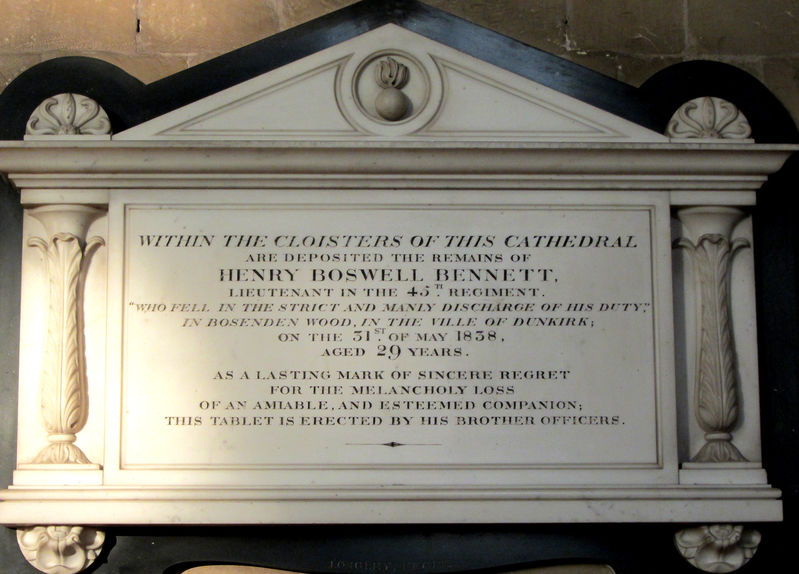
Lt. Boswell-Bennet in Canterbury Cathedral
David ended by telling the tale of what happened to the remaining rioters. He said those that were transported probably had the best of the punishments, although they had a terrible journey, weather wise, getting to Hobart, Van Diemen's Land (Tasmania). The dead rioters were buried at St Michael’s Hernhill. Lydia was amongst those convinced that Courtenay would rise on the third day so the churchyard was guarded and the graves unmarked.
David remarked that the funeral service had no choir since most of its members had been implicated.
Lt. Boswell–Bennett, the only soldier to die in the battle, was buried with full military honours in the Great Cloister of Canterbury Cathedral. Special permission was granted for shots to be fired over him as normally the discharging of firearms was not permitted within The Precincts. A monumental inscription to his memory maybe seen today on the North wall, near the Pulpit, in the Cathedral Nave.
Would that we all had such interesting ancestors.
Report by Tricia Baxter