
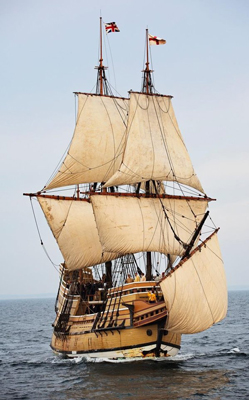
To start his talk Martin Crowther spoke about his interest in Maritime History. Although, he once worked at the National Maritime Museum he first saw the Mayflower, as a model that his father had created.
Martin went on to set the scene of religious intolerance and upheaval of 16th and 17th century England. The persecution and martyrdom of Radical Christians caused a ‘climate of fear’ that on several occasions drove the Separatists to take refuge in Leiden, Holland, until it died down. The Separatists did not want to settle permanently in Holland, as they wanted a new start in a place where they could set their own conventions. This led to a group of Separatists, we know as the Pilgrim Fathers, planning for a fresh start in the New World.
Martin then turned to the Separatists who lived in Canterbury; James Chilton a tailor, his wife, Susanna and daughter Mary, and Robert Cushman. Cushman was apprenticed to George Masters, a Canterbury Grocer who made tallow candles. A rather smelly occupation even for those times. We know a lot more about Robert’s life in Canterbury than we do the Chilton’s since Robert made several court appearances for pamphleteering his Puritan beliefs which are well documented. At the end of his apprenticeship Robert needed to show he was an upright citizen in order to be made freeman of Canterbury. He therefore, stopped his pamphleteering activities until after he was made a freeman of the city and had opened a shop on The Parade.
Robert married Sara Reder in St Alphege’s Church Canterbury and they had a son Thomas in1607/8. Between 1608 and 1620, the Cushman family moved to Sandwich and from there to Lieden where Robert’s occupation was said to be a wool comber. In this period Robert wrote, The Cry of a Stone,' detailing the theology and church doctrine of the Pilgrims, in which he wrote that the Church of England ‘is wanting and defective’. Returning to England in 1619 Robert was involved in organising the Separatists’ move to America and with others he signed, with the Virginia Company, a contract for the right to settle. Robert was also involved in the hiring and provisioning of the ships, Mayflower and Speedwell. The Mayflower was hired from Captain Christopher Jones who was part owner and Master. Local legend says that the signing to hire Mayflower took place in Canterbury at 49 Palace Street. However, documents are yet to be found to support this story.
The departure was scheduled to leave Devon in July 1620, but it had to be delayed for several reasons, including, when they were 300 miles into their journey, having to return to port, as the Speedwell was found to be unseaworthy. Consequently, many passengers from Speedwell had to be crammed on to Mayflower. At this point many wanted to abandon the expedition but Captain Jones would not let them off the ship. Captain Jones was obliged to set sail to repay English merchants who put up money to pay for the voyage. They expected to be repaid with goods to be brought back from North America on the Mayflower’s return. Therefore, it was a jam-packed ship that left England on the 16th September 1620, minus Robert Cushman who was unwell. The 102 men, women and children on board endured 66 days of storms, during which about five died. However, Elizabeth Hopkins, one of the three pregnant women on board, gave birth to a child she named Oceanus.
The pilgrims arrived off Cape Cod on 11th November 1620, which was not quite where they were aiming for, but as the area was fertile, so they elected to stay. Whilst the men explored the area for places to build a settlement women and children continued to live on board Mayflower in damp, cold and cramped conditions. Legend has it that, on the 20th December 1620, Mary Chilton, originally from Canterbury, was the first person to set foot in New Plymouth. The first building to be erected was the Common House, for all to use. But unfortunately, it was the start of a harsh winter and the wrong time of the year to start a Settlement. There was little food and the entire community could easily have been wiped out in the first months.
Martin then talked about the native Americans who helped them, the Wampanoag tribe and Squanto a native who had been captured as a slave but was now free. He was well-travelled and had learnt two languages. The native Americans taught the Pilgrims to survive, plant corn etc and they lived together in peace. The Pilgrims were in more danger from the French and Spanish than the native Americans. Therefore, Captain Miles Standish ordered each man to have five muskets at his disposal.
Unfortunately, the arrival of Europeans brought disease and decimated thousands of natives in North America. Coupled with colonial wars estimates suggest there were 3,000 native Americans before Europeans arrived but by 1620 there were barely 300. This produced an almost empty wilderness in the area of New Plymouth.
On a happier note Martin spoke about the first ‘Thanks Giving’ a big party lasting 3 days which members of the native tribes attended. He also touched on tribal crafts and storytelling through the decoration with Wampum Shells
In the autumn of 1621, the Fortune arrived with 35 passengers including Robert Cushman and his son Thomas. As the Fortune did not bring much in the way of provisions 35 extra mouths to feed was not helpful. Robert stayed only 14 days before returning to England, leaving his son behind in the settlement. Robert’s main purpose in the new colony appears to have been to persuade the Pilgrims to sign the trade agreement with the Merchant Venturer’s Company, which eventually they did. Cushman had quite an experience on the return voyage being captured by French Pirates and imprisoned in Brittany for 15 days. Luckily, the pirates did not take all of the cargo and they were able to return to England with most of it intact. Cushman worked hard on behalf of the Pilgrims until his death at Benenden in 1625. Robert’s son Thomas Cushman married Mary Allerton who lived until 1691 and renowned for being the last of the original Mayflower passengers.
As time passed people were granted a division of land and families moved out of Plymouth to settle in the countryside. Mary Chilton aged 13 when she left England received 3 portions, her own and those of her parents who had died within days of the Pilgrims making landfall. Her father James is thought to have been 64 years old and the oldest passenger on the Mayflower. The Chilton family had once lived by the Cemetery Gate in St Paul’s parish Canterbury and James Chilton’s signature can be seen on the contract to hire the Mayflower. Mary’s bodice survives with its 16” waist and may be seen in the Pilgrim Hall Museum Plymouth. Mary married John Winslow and they had 10 children.
Martin then went on to tell of several famous people and their association with the Pilgrims. He said it is unfortunate that many of this year’s planned celebrations have had to be cancelled or put on hold due to the pandemic but we should keep an eye out for events as many have been transferred to 2021.
Some of the events Martin recommended were:
Mayflower International Genealogical Conference 2021
Wampam: stories from the shells of Native America
Martin answered questions after which the meeting was opened for members to relate their Mayflower stories. .
Report by Tricia Baxter