
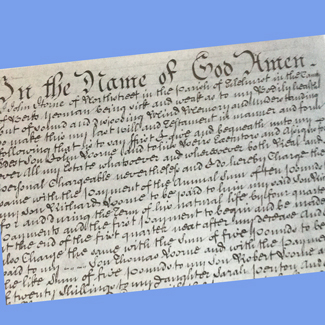
John stressed that his talk was just about the content and not how to find wills. He looked at wills using case studies from his own family to show how family wills can often help sort out connections.
Before 1500 a will and a testament were two separate documents. A will covered freehold or copyhold property such as a house, barn or grazing land and a testament covered leasehold property, chattels, furniture, animals and money. These two documents were gradually merged into one, becoming a will & testament.
Until 1858 all wills and testaments were proved by the Church in ecclesiastical courts and land issues were dealt with in the King’s court Branch News 120 Branch News (Chancery). Executors applied to the local court for probate, providing an inventory and entering into a bond (the value of this was usually double the value of the goods) to complete probate within one year. The court then filed all the relevant papers. In some courts the originals have been kept but in others the information was entered into the Probate book, for instance as in the Prerogative Court of Canterbury. The documents that may be available for research are the will, an inventory and a grant of probate (or administration). Where there was no will the Administrators similarly applied for administration of the deceased’s estate.
Wills usually begin with the deceased including name, sometimes occupation and place of abode. The date can be in regnal format or in “modern” style. This is followed by the deceased’s bequests, usually starting with disposition of the body. It is usually easy to distinguish between catholic and protestant but if the phrase Non-conformist. At the end will be signatures and witnesses. If the testator marks rather than signs this may just be due to health rather than illiteracy. Relationships can be confusing, modern terms are not always the same as they were. A brother in law in the 1600s could be a step brother or a half “at the discretion of my executors” is used this may indicate a brother. Kinsman often meant nephews while cousin could be by marriage, or a more distant relation. A useful trick is to put the words “in law” before the relationship and then see how we would interpret it now.
The nature of bequests or lack of them can also be very revealing. Leaving a shilling doesn’t always mean that the legatee was out of favour but rather that he, or she, had already been provided for by other family members. Of course it could be that they were estranged and by leaving a shilling it would reduce their options of contesting the will as it proved they had not been forgotten.
Using wills from the wider family John showed how it was possible to identify who was who, where the parish registers did not make this clear, so he encouraged us all to get everyone that could be connected.
Report by Sheila Harris