
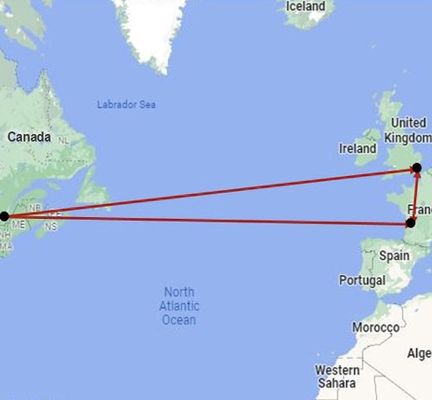
covered in the talk in
England, Canada and France
Mick started by saying he’d been born in Toronto to a French-Canadian soldier and an English war bride mother. In 1952, after the break down of the marriage, his mother returned home to Canterbury with Mick and his siblings and they grew up in the Westgate area of the city. He knew his father was Canadian, but he didn’t find out about the paternal side of his family until after his mother died and he was able to read family papers. Now ready to investigate the Bernier side Mick said, “There weren’t many Bernier’s in the UK, so how hard could it be?”
He started by contacting the 36 Berniers named in the Toronto Yellow pages. There were few replies and although some wished him well others were aggrieved due to the English connection. Having drawn a blank with Berniers in the yellow pages he turned his attention to his parent’s divorce papers. He discovered his father’s solicitor was still practising all these years later and still remembered Mick’s father. Unfortunately, he was only able to give a minimum of useful information but he did send Mick a pack of documents. These helped Mick start off on his Bernier line research, which led to him to getting his tree back to 1447 when his family lived in Montpellier-de-Medillan a small village in France.
The Bernier family appeared to be wealthy, which by the 1640’s was not a good position to be in, in France. By 1650, France was in turmoil and Mick’s ancestor Jacques Bernier, who was living in Paris at the time, took ship and sailed to Quebec, which was developing as a French trading post. At first the French settlers had help from the Huron Indians but not from the Iroquois people who favoured the British. Men had to work for 3 years before they were able to acquire their own land. Mick’s ancestor Jacques served his apprenticeship and was granted land on the Ile de Orlean an island in the St Lawrence River close to Quebec.
There was a severe shortage of women that was hampering the growth of the colony and a scheme was set up managed by Nuns known as the ‘Fils de Roi’ or The Kings women. Over a short period, 800 women were found to travel to Canada as brides. They were given a contract with a small bag of gold and were able to choose their own husbands, a rare opportunity available to few women in that era! If after 6 months they did not find a suitable man to marry they were able to return home, but only 33 did. They were not prostitutes as some accounts suggest but respectable women of low social status or orphans. Jacques Bernier was chosen by Antoinette and they went on to have 12 children. From these marriages of the ‘Fils de Roi’ a total of 4,445 children were born with only 15 dying in child birth. The survival rates were far better than if they had been living in France or England. Indeed many of these women outlived their husbands and married again.
Mick described the lands where Jacques and his family lived. The British were endeavouring to take over Canada, with the help of the indigenous tribes. Jacques, his family and other settlers were caught up in a number of vicious incidents where property, crops and people were destroyed. Existence was tenuous. So, in 1667, Jacques sold his land on the island and moved to a heavily wooded area on the opposite side of the St Lawrence River. Mick explained the Seigneur system of land settlement and said that the Seigneur was required to build a mill and a church for his settlers. Jacques was the very first settler on the South bank of the St Lawrence River and when he became a Seigneur himself, his house served as a chapel for visiting missionaries.
Having founded the town of Cap St Ignace. Mick’s branch of the family established themselves down the generations working in the logging trade, clearing forests and transporting wood down the many rivers. They were caught up in the global conflict of the Seven Year war (1756-1763) and must have been at the Battle of the Plains of Abraham in 1759 when both leaders, the Kentish General Wolf and the French general Montcalm lost their lives. Mick showed the area of the battle superimposed on a map of Quebec City. He calculates that at least six members of the Bernier family must have served with the local militia, but could not find any surviving militia records to prove this. The war left families impoverished, under British rule and having to start over again.
The Bernier’s spread rapidly along the south bank of the St Lawrence. Following a move to St Etienne des gres in 1859, the family were to move yet again, arriving at Lake Huron in 1891. Some moved onto Aird Island a large logging mill. Byng inlet Cemetery is the last resting place of many Bernier ancestors. Mick’s grandfather moved to Michigan in 1913 for work, but by 1924 the family had moved to Toronto, where his grandfather owned and ran a barber shop until his death in 1952.
Bringing his talk to a close he showed a DNA sample map of Berniers throughout the world and remarked how prolific they were.
Mick visited both France and Canada in an effort to pin down this side of his ancestry. In doing so, he discovered, and has established contact with, a half-sister and a 1st cousin that he did not know he had.
It was fascinating talk and Mick has found other forefathers such as his trapper ancestor after whom Byng Inlet was named. He said his tale would need a talk just to himself. Consequently, we are looking forward to another enthralling talk by Mick. Hopefully, in the not too distant future.
Report by Viv Carter and Tricia Baxter