
A recording of this talk was aired on 21st January 2021
On the eve of the 101st Remembrance Day, Megan Maltby, Senior Public Events Coordinator at Commonwealth War Graves Commission, gave a virtual talk to our members worldwide entitled Commonwealth War Graves Commission; the work continues...
Meghan started with a video outlining the work of the CWGC (Commonwealth War Graves Commission) followed by some statistics. CWGC commemorates 1.7 million men and women of the Commonwealth and maintains 1.1 million headstones at 23,000 locations around the world. The youngest casualty is only 14 years of age whilst the oldest is 68. The cemeteries range in size from Tyne Cot, Belgium, which is the largest containing the remains of over 12,000 people, to the smallest at Ocracoke Island, North Carolina, USA where just 4 people are buried. The start date for those the CWGC honours is the start of each of the world wars: 4 August 1914 and 3 September 1939 respectively. However, the end of war date is not so easy to arrive at because fighting continued for various reasons after the official cease fires were declared. Hence WWI burials go up to 31 August 1921 and WWII to 31 December 1947.
Before the first World War it was rare for soldiers to have marked graves, and only a few of them were able to be repatriated back to their homeland for burial. This was the case until early 1915 when repatriation was stopped. This was because it was becoming an impossible task due to the sheer numbers of the dead involved. As per customary practise combatants were buried by their comrades either where they fell, or in cemeteries behind the lines.
On 10th May 1915 a Royal Charter set up ‘The Imperial War Graves Commission’, this was the forerunner of the CWGC; the name was changed officially in 1960. The Royal Charter arose from an initiative by Sir Fabien Ware who wanted to do something for the war effort but was too old to fight. Instead he joining the Red Cross, where he was put in charge of a unit near the Front. He was shocked to find that there was no system to list the fallen nor to bury them. Hence, he and his unit began recording the fallen and marking their graves.
The Royal Charter established that each of the Commonwealth dead should be commemorated by their name on a headstone or memorial that should be permanent. Memorial stone should be uniform with no distinction for rank or status. Although, the work did not start in earnest until after the armistice it was the beginnings of what Rudyard Kipling described as being “The single biggest piece of work since the Pharaohs...”
The Commission’s aim was that the fallen would each have their name on a headstone or memorial which could be the focus for their loved ones to visit, leave flowers etc. After the war the work began by removing the remains from small grave sites to be reburied in larger cemeteries. But there had been so much fighting across the same ground that many of the grave remains from earlier skirmishes had been lost.
Those that could not be identified are buried alongside their named comrades with the epitaph ‘Known only unto God’ on their headstone. The names of the missing are on memorials: such as the Menin Gate, which lists 56,000 Officers and Men, and Thiepval, that names over 72,000. Those lost at sea have no grave but are named on various Memorials throughout the world; such as the Chatham Naval Memorial that names over 18,000, of which there are 20 sets of brothers who all served at sea.
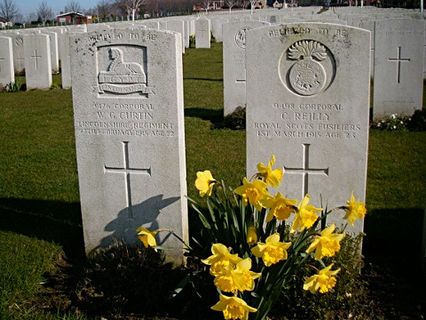
Megan showed examples of headstones and how to read them. If you see two stones overlapping it’s because although they know the names of the two soldiers it had not been possible to determine which was which. Hence, they were buried alongside with overlapping headstones so the Commission are certain that at least half the stone is over the right person. However, each government has different rules. For example, the space at the bottom of the stone which is for an epitaph from the family, if they choose to have one, was vetoed by the New Zealand government at the time. Hence, none of the New Zealanders’ headstones carry an inscription from their families.
We were told about a few of the difficulties in maintaining some cemeteries. Such as the Basra Cemetery in Iraq where constant conflicts have made the situation dangerous for CWGC staff. They frequently have to withdraw CWGC personnel until the situation calms and is safe enough for staff to return. They also have difficulty in Iraq due to the sandy ground which is so salty that it eats away the headstones. Another cemetery on a remote Scottish Island commemorates the crew of a plane that crashed there. The plane was left as a marker but over the years it disintegrated and the CWGC were informed that the crew’s last resting place could soon be lost. Megan said it is one of the remotest sites the Commission look after and was not easy to access nor suitable for a standard headstone. A granite memorial, that had to be installed by helicopter, now marks the site.
Today the Commission is involved in educating people so the stories of the sacrifices made are not forgotten. Megan said although they are not responsible for the CWGC burials in local churchyards they work with those responsible to ensure that graves are not lost through neglect. She recommended that we visit some of the exhibitions and museums sponsored by the Commission, once pandemic restrictions are lifted. There is an excellent World War Experience at Beaurains south of Arras in France, and the exhibition at Runnymede tells some of the stories of the contribution of some 200,000 airmen and women.
After the talk Megan answered several questions from members. In reply to the neglected pre-WWI military graves at Shorncliffe, she said earlier military graves (before the world wars) are not their responsibility. However, when they form part of one of their Cemeteries, they often end up having to take them under their wing. Megan said if we should find any CWGC burials that are in a poor condition or threatening to be destroyed to please report it to them. There is a department who follow up such reports and someone will come and look at the problem without delay to plan any necessary action. You can make a report via their website.
Report by Tricia Baxter