
A recording of this talk was broadcast on 19th March 2021
Ann Ballard, our speaker is a professional genealogist and a Licentiate of the IHGS at which she tutors courses in Genealogy and Heraldry. The latter subject being her particular interest and passion. Ann said it would be a whistle stop tour as Heraldry is a different language with a vast range of terminology, colours, designs etc. which she would not be able to cover in only 1/ 2 hours. To see good examples of Heraldry Ann recommended visiting Arundel Castle as their displays are fabulous.
Heraldry is governed by law with the College of Arms being the Authority under the 1484 Royal Charter, to confirm, grant and control the design of Arms. The three Kings of Arms: Garter, Clarenceux and Norroy & Ulster head a line-up of Heralds and pursuivants with Garter being the ‘top dog’. Ann said there are many regulations that should be observed by law but like all things, rules get broken.
Arms were historically important as identification to tell friend from foe in battle or the joust. They could also be used on seals to confirm contracts. In family pedigrees they can identify and confirm hereditary descendants and as such are another resource to potentially trace a family.
We don’t have to go out of our way to see Heraldry as it is on churches, public buildings, private houses, book plates, stained glass windows etc. One might even be the sign on your local pub, as often pubs were named for the gentry family local to the area.
Ann said it is inaccurate to refer to Arms as a Family Crest as the crest is only part of the design. Using the labelled Arms of the Heraldry Society Ann clarified the names of the various parts of the design. The central part is the shield and, as historically only men went to war, it is usually only on designs for men. Normally, a lozenge takes the place of a shield for females. Ann then went on to explain that right and left (dexter and sinister) of a shield is from the point of view of the person holding it and spoke about the various, colours and shapes of shields.
There is no limit to objects that may be used in the design. It could be a tool for an occupation, a castle, cross, weapon, star, flowers, bird, fish, animal etc. Ann used the Lion to describe the various different positions animals might take such as rampant (rearing up) passant (standing with one paw raised) guardant (with head facing front) etc. The terminology is necessary to understand the written description or blazon and the tricking or abbreviations for colours. Hatching is also used when colours can’t be displayed such as on a stone or marble carving of the arms.
On marriage Arms can be joined or impaled with the wife’s arms on the left (sinister) side of her husband. Ann said you can make family trees up by understanding the Arms on tombs in a churchyard.
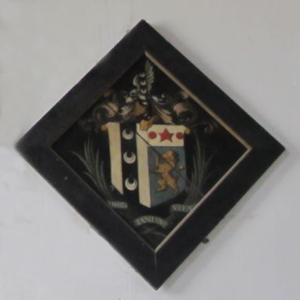
Hatchments are the lozenge shaped boxes usually seen on church walls. They show the arms of the deceased and are worth studying as much can be told from them about a family. If they are for a married couple and half the background is white and half black then the wife survived her husband.
We were advised that overtime colours can change and be dirty making a blue seem black etc. Also due to renovations in churches some Arms may not be as they were originally. Ann showed a couple of instances when odd shields were gathered together but on further study it was found that the families were nothing to do with each other.
In a Case Study Ann checked an image of a monument against a written description. She translated the terminology to decide which branch of a family it related to.
Ann suggested reading local authors of centuries past such as Hasted for Kent and gave a bibliography of books you may find useful.
The first two books can be read online at:
Burke’s – The General Armory (1884) - to identify the written description from a family name.
Papworth’s Ordinary of British Armorials (1874) - to identify the family name from the written description.
George W Marshall, The Genealogist’s Guide (1903) which should be read with
J B Whitemore, The Genealogical Guide (1953)
Geoffrey B Burrow, The Genealogist’s Guide (1977)
T R Thomson, A catalogue of British Family Histories (1980)
Peter Summers ed. Hatchments in Britain – Vol. 9 Kent (author B Bond)
An extremely intricate subject made enjoyable and understandable by an excellent speaker.
Report by Tricia Baxter