
A recording of this talk, was aired on the 25 February 2021.
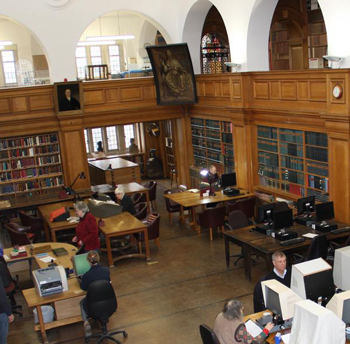
Canterbury Cathedral Archives
Cressida Williams is the Archives and Library Manager at CCA (Canterbury Cathedral Archives). She started her talk with some statistics about the archive which is the largest collection of any Cathedral archive with 1 km of shelving. It holds the records of the Cathedral, the City of Canterbury, (and is unique that it works in partnership with its city), East Kent parish records and numerous local collections that have been entrusted to CCA for safe keeping over many, many, years. The archives were once part of Kent County archives but when the History and Library centre was built at Maidstone, they became independent of each other. However, the two Archives still work closely together, with CCA now run by The Dean and Chapter of Canterbury Cathedral.
The Cathedral’s medieval collection has received the UNESCO Memory of the World award which is the equivalent of World Heritage status for archives, complimenting Canterbury’s physical World Heritage sites: The Cathedral, St Augustine’s Abbey and St Martin’s Church. The Medieval collection has been on this site for many hundreds of years with the earliest documents being older than the cathedral we see standing today. The index to the collection may be viewed online but Cressida advised that it is not easy to find your way around the current catalogue.
Cressida showed slides of some of the ‘jewels’ in the collection starting with the Godwin Charter written in Anglo Saxon in the 9th century. Although, many of the alphabet letters can be recognised today the language is very different. It’s a charter for the sale of a piece of land near Boughton Monchelsea between Godwine and Leofwine and is in the everyday language that ordinary people would have understood. It was duplicated or replicated as may be seen by the letters along the bottom which have been cut in two. This was to recognise any alterations that might have been made when the parts of the documents were put together like a jigsaw.
Next up was the Accord of Winchester 1072 which is an agreement that the office of the Archbishop of Canterbury is Senior to that of the Archbishop of York. It is autographed (marked with a Calvary cross) by William the Conqueror, his Queen Mathilda, and signed amongst others present, by Archbishops Lanfranc of Canterbury and Archbishop Thomas of York. It’s due to go on display in the crypt exhibition area by next year.
The Archives hold a contemporary copy of the 1215 Magna Carter, which is most important to the cathedral as is its first line states “The Church in England shall be free”.
Cressida then spoke about the parish collection and displayed a map of the Kent parishes colour coded to indicate which archive holds the records. Also two booklets about the whereabouts of parish documents in East and West Kent respectively.
David Wright’s East Kent parishes (2002) is still very useful, even though there have been changes in recent years. Cressida said that CCA had a few left and to email her if anyone wanted to buy one. Otherwise, David Wright’s website suggests that he still has some copies for sale.
There is also a useful Guide to Kent parish registers published on the Kent Archives website
Original registers can go back to 1538, although only two Canterbury parishes St Andrews and St George actually do. Those new to parish registers should keep in mind the date change in 1752. Before that year the 25th March (Lady Day) had been the first day of the new year. Cressida said if you look at the original pages of registers you will find many things of help and interest. She showed several examples from the parish register collection. The strikingly clear hand (Oh how we would love all registers to be so clear and concise) of Thomas Hill mapmaker and clerk to St Paul’s parish Canterbury. The unkind and odd remarks of Thomas Patten vicar of Seasalter in his composite register, and the most helpful vicar of St John in Thanet who recorded the cause of death in his registers. A printed register from Deal showed how high the infant mortality was in that parish at that time. Whilst the burnt pages of the register (thankfully already transcribed) from St George’s Canterbury symbolised the story of the bombing of Canterbury in 1942.
Cressida spoke about the Parish Chest and the Poor Law Act showing money coming in and out in the pages of the records of St Paul’s Canterbury for 1614. She then listed some other records that CCA hold. The Walloon Church registers have been transcribed by the Huguenot Society and are no longer held at Canterbury. However, CCA still hold other records of the French Church and also some non-Anglican records which are usually held in KHLC or archives in London. Freemason’s Records are indexed and hope to go online via Findmypast in the nor too distant future. CCA has a wonderful collection of maps and photographs.
Kent Manorial Records have just gone online and there is a helpful interpretation on the KHLC website Its very name rich It’s a complicated landscape but gives information about country life and individual manors and where each Lord of the Manor held lands. It also shows that the cathedral held manors as far away as Devon. Unfortunately, due to the reformation when documents were moved or destroyed few have survived from the Medieval era.
Finally, Cressida mentioned the Cathedral Library which holds 30,000 pre-1900 books. It includes the Howley-Harrison collection, parish collections, church history and theology. Helpful to family historians are Crockford’s Clerical Directory, University Registers, the Gentleman’s Magazine and more.
In question time Cressida was asked about lack of 19th century registers online and the poor quality of some films in comparison to those from KHLC. Her reply was that East Kent parishes went online several years earlier when the capacity to re digitise was not an option. There are plans for this to be rectified in future although she didn’t know when.
Although, currently closed due to pandemic directives you can still contact the archives via email: archives@canterbury-cathedral.org
Report by Tricia Baxter