
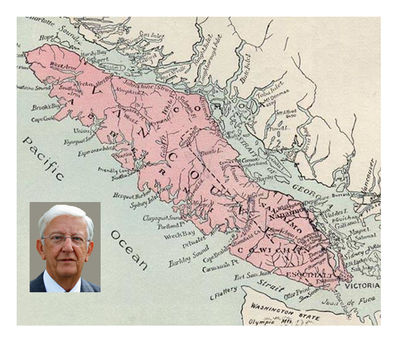
This evening's speaker, John Flewin started his career in journalism as a reporter on the Leighton Buzzard Observer. Amongst other roles in he has held during his long career were news editing roles for BBC radio and later he was News Editor of ITN’s News at Ten.
John started with the remark that having an uncommon Surname such as Flewin is helpful for a Family Historian. Searching for the Surname, he came across the 1781 marriage of an Edward Flewin in Farningham Kent. That started him on a line of research which led him through many sources; such as ship’s logs, family trees, newspaper articles, poems and a diary to examine the fascinating story about a group of Vancouver Island’s first settlers.
John’s distant cousin Thomas Flewin and his wife Jane were amongst 27 people from four villages in the Wilmington/Farningham area of Kent, who boarded the ship the Norman Morison at Greenwich. Thomas and Ann had married at Wilmington, St Michael & All Angels church, in July 1852 and a few months later they left for Canada. On board the Norman Morison the group from Kent met other migrants from Essex and a very large one from Scotland who doubled the settlers’ numbers. Many were general labourers and all had signed up for 5 years.
The education system in Scotland being better in those days than in England, the Scots were well able to record the venture. It was from the writings of two of their number, a poet and a diarist, that John was able to enhance the story about the lives of the settlers both during the long voyage and in the following years on Vancouver Islands.
As John had said in his title it was probably amongst the longest emigration voyage in history taking five months without making landfall. Although, the first month’s sailing was fine, promising a good journey, the weather turned bad with storms. There were two deaths and a birth before they rounded the Horn. Throughout the rest of the voyage the settlers, no matter which of the three classes of passenger they were, endured bad weather. As they rounded Cape Horn, they were hit by hurricanes, Ice bergs and treacherous seas. The passengers must have spent their worst Christmas Day ever. Even the seamen were showing the strain of such a voyage. The ship’s log book records that Mr Nugent, the Chief Officer, had to be confined to his cabin, due to being intoxicated and quarrelling with the crew! The ship’s log also included baptisms undertaken by Captain Wishart, as Master, during the journey.
By the 10th January 1853 they were at last in sight of their port of destination on Vancouver Island. But the weather was still against them and the ship was nearly dashed against rocks. They were then forced to spend a further 4 days trying to gain landfall. Every evening, as the ship neared land, the high seas swept it back. They were eventually able to sail slowly up the Sound and weighed anchor in Royal Bay.
Upon landing the accommodation they had expected was basic and squalid and far from what had been promised. John’s story continued with quotes from the diary of Robert Melrose in which he covered the conditions, discontent and relationships with the native people. Melrose had an amusing way of indicating the level of drunkenness of his various companions. They were said to be either a quarter, a half or whole drunk and on one occasion he wrote that he was whole drunk!
John followed the families of several settlers many of whom were well respected at the end of their lives as was demonstrated from their epitaphs. Also, in that that their names live on today in many places names on Vancouver Island.
This was a most interesting talk very professionally presented with a pre-recorded video and included film clips. The voice overs to read the quotes from the poems and the Diary had apt Scots accents that helped to enriched the tale.
Report by Tricia Baxter