
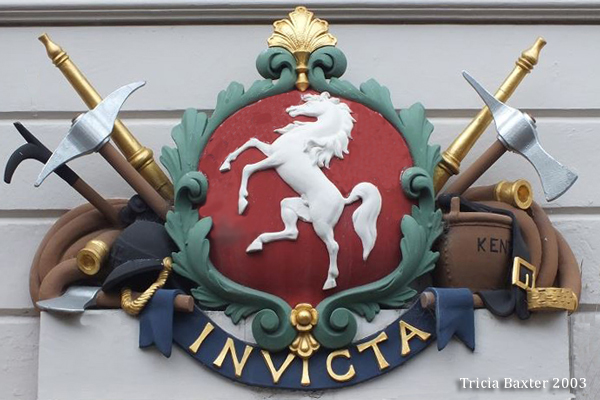
Our speaker this afternoon, was former career fire fighter Howard Myers who spent his Fire Brigade service in, Kent, Central and East London. He is now heavily involved with the Kent Firefighting Museum at Ash Near Sevenoaks.
In his illustrated talk ‘A history of fire fighting in Kent’ Howard started with the Neanderthal and Stone age people. Although, he said the true start of fire fighting in Kent can be dated to the Roman invasion of 43 AD when the Vigilis (slave firefighters) were introduction into Britain.
Sometimes called Spartoli (little bucket fellows) the Vigilis had been formed after a huge fire destroyed a quarter of the buildings in central Rome in 6 AD. The Vigilis, commanded by the Viciomagister, enforced preventative measures such as, every home had to have water in upper rooms ready to put out fires. In the Roman Military every cohort, or unit, had standard firefighting equipment, including a Sipho (fire engine with a double action pump). Some Vigiles were also Aquirii, and had to know, instantly, where water could be found. At first the equipment and methods were basic, buckets made of rope and pitch, ladders, and long hooks to pull down buildings to make fire breaks. But over time they developed additional firefighting equipment including the Archimedes screw, to raise water from a lower source, and acetums an early chemical method of dousing a fire with wine that had turned into vinegar. Unfortunately, as with many other Roman innovations, there is little evidence that when the legions finally withdrew from Britain, that their firefighting methods and systems were continued.
One of the first fire safety laws recorded in England was introduced by the Normans circa 1068. The law required every household and business to extinguish all flames before going to bed. The cry at the 8 o’clock bell was, couvre feu (cover fire) a term which has come down to us today as Curfew. An Act of Parliament in 1556 required patrolmen to walk the London streets ringing a bell with a cry that started with: “Take care of your candle ...”.
Around 1650 wooden water mains (hollowed out logs) were introduced and started the first permanent supply of water into towns. In order that firefighters could find the water supply more easily Fire Plugs (brick markers) denoted the source. Water then had to be collected and delivered from the ‘mains’ to the fire in buckets to be squirted onto the fire by large syringes known as ‘Squirts’.
After the Great Fire of London (1666) insurance companies started their own fire brigades. We can still see the insurance companies fire marks on old buildings today. When called to a fire the insurance company’s fire brigade would keep any eye on the progress ro make certain it did not spread to any of the buildings they insured, but otherwise they would not tackle the fire unless a building with their mark on it was compromised.
The first volunteer fire brigade in the county was formed about 1802 by the Hythe Fire Engine Association. Howard showed images of the engine and explained how the big hose would be used to pump water up from a pond or river whilst the smaller hose would spray the water onto the fire.
By the mid-19th century nine of Kent’s main towns and cities had fire brigades and the London Fire Brigade had been formed. Firemen were issued with uniforms including a leather helmet. Howard talked us through key dates and innovations brought about by men such as James Braidwood (1800-1861) followed by Captain Sir Eyre Massey Shaw (1828-1908). Howard said that the latter had considerable influence in the formation of local fire brigades throughout the country and has gone down in history as the ‘Captain Shaw’ in the Gilbert and Sullivan operetta Iolanthe.
Brass Helmets had to be replaced when electricity was brought in and we were shown a damaged helmet that had melted when exposed to electricity.
Coming on to more modern times and the development of fire engines from horse drawn, to steam powered, and petrol and diesel. Howard showed a photograph of his own vintage fire engine which he takes to events and said that many of the other engines he has shown photographs of can be seen at the Kent Firefighting Museum.
Moving on to the twenty-first century Howard spoke about electric fire engines, and whether their batteries can last the length of time they have to be pumping at an incident. He said that one of the state-of-the-art hoses in use today can pump water on a fire through brick walls! (Would that we had something similar to deal with our brick walls).
A thoroughly interesting talk after which Howard took several questions including dating the photograph of a member’s firefighting ancestor.
Not all speakers will allow their talks to be recorded. Therefore, we are grateful to Howard for kindly allowing a recording in order that our members ‘down under’ can listen to it at a more convenient time for them: 8 am (UK) on 19th November 2020.
Report by Tricia Baxter