
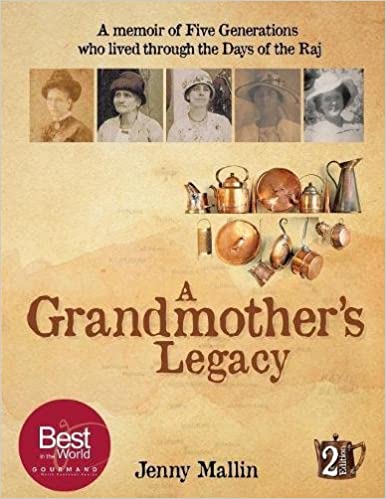
A Grandmother's Legacy
Our speaker Jenny Mallin has written several books about women in the British Raj. The subject of this talk being one of them. How life was for her grandmothers, having to run a household complete with as many as 20 servants.
Jenny explained that the term Memsahib was used to address married upper-class European Ladies in the days of the British Raj. ‘Mem’ being a corruption of Madam and Sahib the respectful way to address a European man. Jenny described how life was for these intrepidly ladies who travelled to India in the time of the British Raj.
The 18th century was the era of Clive of India, a time when the East India Company was at its height and many young men were going out to seek their fortune. Women in this period had little status without a husband and consequently those from the middle and upper classes were expected to marry to gain social standing. However, with so many eligible bachelors going overseas ladies who wanted to find a suitable husband had to follow them.
Upon arrival in India, after a cramped and uncomfortable journey, Ladies had one year in which to find a husband or return home to England single, and hence an object of pity in society. A dinner was often held on board before disembarkation and the prettiest females were immediately snapped up before they set foot on India soil. Church on Sunday was another source for ladies to be seen by likely suitors. Unfortunately, plainer females might have to travel into the countryside to meet prospective husbands who, having had little opportunity to meet suitable European women, would not be too fussy. Men outnumbered women to such an extent that it was not unknown for widows to be approached with an offer of marriage at their husband’s funeral!
Despite the hot stifling heat Memsahibs were encouraged to dress as they would at home in layers of clothing and tight corsets. At events where local ladies were present the Memsahibs would often be overshadowed by Indian ladies in their lovely silk saris. There were endless activities and social events that they were expected to join in, such as Bridge parties, Tennis, Tea parties, amateur dramatics etc.
Life being so different from home newcomers needed to take advice from older ladies about how to cope with the heat, insects, animals invading their home, medical matters, hiring of staff etc. Several of the long-term inhabitants, such as Jenny’s grandmother, produced books on Housekeeping in India which gave much needed help and advice. Not only did Memsahibs care for their husbands and children, but an assortment of servants came under their wing too. In remote areas a Memsahib might be the only European lady in the vicinity with no radio, telephone, fridge etc. Medical help could be days away and she just had to cope on her own with tropical diseases such as typhoid, malaria, cholera and plague. Naturally, it needed a certain type of woman who could put up with it all.
Jenny described the living quarters aided by photos, plans. The quarters were mostly in compounds with outbuildings comprising of servants’ accommodation, kitchen and other working areas. An enclosed garden was around the main Bungalow. Bungalow is an India word meaning a Bengal style house. It was shaded by a veranda (another India word) on all sides where the inhabitants could sit away from the sun. The windows and doors opened on to the shady veranda which helped circulate cooler air in the house. Loose carpets had to be shaken twice a day to keep them bug and dust free. Most places had a Punkah wallah, whose sole job was to pull a string connected to material that wafted back and forth causing a draft, to help keep everyone cool. A monotonous job, coupled by the intense heat Jenny said that the punkah often dozed off.
Most of the servants were male and Jenny explained their various occupations and the Indian terms for them. Chokra Boy cleaned rifles and shoes, the Mali or gardener had to grow and provide fresh cut flowers for the house every day. The Darwan, or night watchman protected the family whilst the Dhobi wallah washed the clothes. The Hajam (Barber) would visit every morning first thing to shave the man of the house. Jenny described how the milkman brought the cow to be milked it at the back of the house and the children of the family would take turns checking that the he didn’t water down the milk.
The Aya or nanny would have sole charge of the children and formed very close links with their English charges. The children spent 100% of their formative years with their Ayah and many were often fluent in Hindi. There were many tears on both sides when the children were sent to England for their schooling. The boys when aged 7 years and the girls aged 10.
When hiring servants, the Memsahib had to consider not only the applicant’s ability to carry out the role but that their caste and religious beliefs would fit in with the servant household. Hence, she had to consider the 4 castes of Indian society and she couldn’t employ a Muslim waiter to serve alcohol, nor a Hindu to prepare or serve beef.
When new clothes were needed a cloth merchants would come to the home with their samples and tailors would be employed to make the garments. On big occasions, such as weddings, tailors could be residents for a month.
Jenny ended by saying that nothing in India was like it was at home and yet despite ups and downs the Memsahibs dealt with whatever life threw at her to ensure the happiness and comfort of her family.
Anyone researching their family in India Jenny suggested ‘Families in British India Society www.fibis.org/ as being most helpful.
Report by Tricia Baxter