
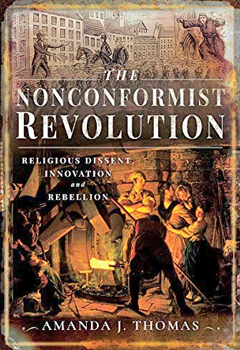
Nonconformist Revolution
Amanda J Thomas
In September we had a good turnout to listen to Amanda Thomas talk about “The Non-Conformist Revolution”
The roots of protestant dissent can be traced back to the fourteenth century. The mediaeval feudal social structure was pyramidical with the King and Church at the top, followed by the nobility and then the majority of the population; Freemen who occupied small amounts of land and may have a trade and serfs who were totally bound to the lord the manor and had no property of their own. The Church was very wealthy and had a lot of power, spiritual and secular, over the people.
During the fourteenth century several very poor harvests led to famine and this coupled with waves of plague, the Black Death, resulted in the population being halved and there was great rural poverty. However people were still expected to pay their tithes, usually 10% of their produce, to the Church. There was a lot of resentment to this especially among the freemen class, who began to question why this was happening and where was God? This led to a general interest in education.
John Wyclif c1328-1384, was the first well known dissident who questioned the wealth and pomp of the Church. He and his followers translated the Bible from Latin into English so that it could be read by the ordinary people. Recent research has shown that although very few people other than the nobility and those trained in monasteries could write a large percentage of ordinary people could read and that it was the women who were the educators. There was a big growth in Grammar schools for those able to afford it and also Dame schools and home learning up to about seven or eight years of age for those who couldn’t.
The generations who followed Wyclif were increasingly questioning the validity of the Catholic Church as they could find nothing in the Bible to support idolatry, prayers for the dead, indulgences to speed one through purgatory, crusades etc. These people were generally known as Lollards. Some were open about their dissention whilst others kept a lower profile and still attended regular church services. But they had an increasingly good network of communication across the country and by the sixteenth century these ‘middling sort’ of people (merchants, clothiers, artisans etc) had regular trade connections with others who held similar views. Because most of them could read the spread of written pamphlets and broadsheets available fairly inexpensively promoted their cause.
Thinking outside of the box on religion also promoted interest in science and technology and this spread along the trade routes. Protestant thinking was being embraced by people working in trades such as cloth and weaving, mining and metal working, glass making, papermaking. There were also many protestant people coming to England from the continent, most especially the Huguenots who were fleeing religious persecution.
During the civil war Cromwell enrolled people from all non conformist backgrounds for his new model army and even after the restoration these people remained in tightly knit communities. By the eighteenth century there were a great many dissenting sects with varying views but generally they all wanted a simplification of belief. Quakers especially favoured self reliance and hard work. The Wesley brothers’ promoted an evangelical Christianity based on the scriptures and a belief in salvation for all.
These groups of people in tight knit, inter-married communities with similar religious beliefs had good educations (although they were barred from universities) laid the foundations for the industrial and philosophical revolution. Many of them are still household names today. James Watt, Samuel Priestly, Josiah Wedgwood, Joseph Fry, John Cadbury …
In a nutshell; the people who questioned traditional religious belief were also the people who thought about science and technology.
----------------------------------------------
Report by Brenda Paternoster