
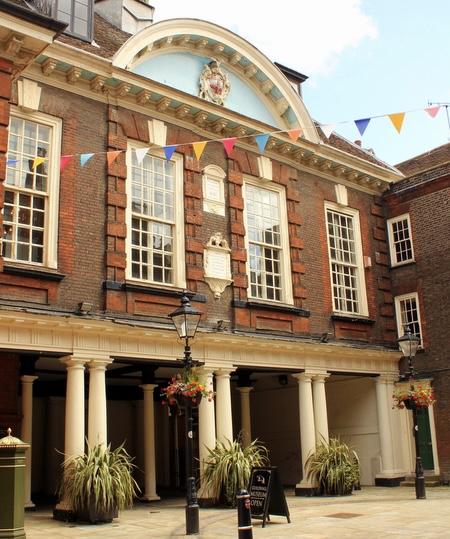
Dr Jeremy Clarke, is the Education Officer at Rochester Guildhall Museum. He lead us through a series of local nineteenth century political posters which now reside at Medway Archives. They had been collected into a scrapbook by a person or persons unknown for an equally undisclosed reason. On locating the scrapbook, Jeremy spent much time researching the information contained within it and interpreting what he found.
The posters, produced around two hundred years ago, were described by Jeremy as ‘dense’. They contained lots of writing and many references to people and issues of the time. Satire was used extensively and, although they may not look like the colourful posters of today, they served their purpose. People would gather around them and talk about the information they contained.
Jeremy talked us through the changes to our political system as it developed with the Great Reform Act. He told us of the political system pre-reform, containing counties and boroughs of varying sizes which would return Members of Parliament. Boroughs we’re not as we know them today and could change in size over time - becoming larger or shrinking in size so as to have effectively disappeared (rotten boroughs), whilst retaining their two MPs! Although at the time there was no legal bar to women voting, custom dictated that they did not. County MPs were elected by those who qualified to vote by virtue of owning the freehold of property worth 40 shillings or more. In boroughs, qualification to vote varied widely but it all added up to a system open to widespread abuse.
We were guided through ‘The Humours of an Election: The Polling’ by William Hogarth which portrays the broken, corrupt state of British politics with satire oozing out of every brush stroke.
The eighteen thirties saw much change. When the Prime Minister, the First Duke of Wellington, declared in 1830, that he was not going to introduce any electoral reforms because the system was perfect as it was, he single-handedly brought down the government. Charles Grey became PM in his place on a reform ticket. Although legislation was twice knocked back by the House of Lords, each time with increasing unrest in the country, 1832 finally saw change.
Following legislation, many of the rotten borough constituencies were abolished, other small boroughs lost one of their previous two MPs and 67 new seats were created, mainly in areas that had increased in population size due to the industrial revolution.
Against this backdrop of national political change, the posters provided a look at local thoughts and feelings about the politics of the time. All in all, a thoroughly informative and enjoyable talk.
Report by Helen Stenhouse