
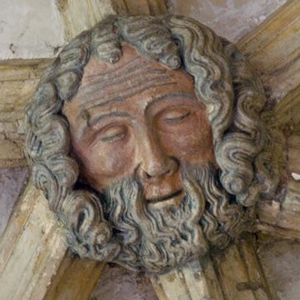
Roof Boss, Great Cloister
Canterbury Cathedral
This afternoon, Medway branch were treated to an illustrated talk by Imogen Corrigan. Her interest in cathedral construction stems from asking, as a 14 year old, ‘How did they do that?’ Imogen took us on a whistle-stop tour around Europe to learn about the ‘master masons’ - who weren’t necessarily masons at all.
A master mason was the person in charge of designing and carrying out the project. He might have started out as a mason, a stone cutter, a carpenter or in some other craft and gradually moved ahead of his peers. Whatever background he came from, he would have needed two essential attributes: the ability to design and the ability to manage a huge building project.
Much is known about the actual construction process from many artworks made during a build. If you had a church built, you often had the process immortalised in paint. Master masons often feature in these images, along with some of the many people involved in the build. Indeed, it was not unheard of for well over a thousand workers to be working on a site. The noise alone would have been deafening. Only around ten percent of those workers might be locals. The majority would be skilled craftsmen living in a town of huts that would grow up around the construction site.
Although elaborate designs were initially envisioned, these could take more than one lifetime to carry out. Often, a new master mason would need to be commissioned to continue the work of the first - there are instances of master masons falling to their deaths. The time, materials and workforce involved in constructions meant that costs were huge.
A common misconception was explained. Mason’s marks, the small marks carved into stones in a building to identify the person working there, were a means of keeping track of the amount of work completed by each mason. Master masons had no need for these. They were professional; their role was a salaried position. A master mason could command a sizeable salary and other perks too. Those most in demand achieved almost celebrity status.
More information can be found in Imogen’s book, entitled ‘Stone on Stone: the men who built the Cathedrals’. Available from Waterstones, Amazon, WH Smith etc.
Report by Helen Stenhouse