
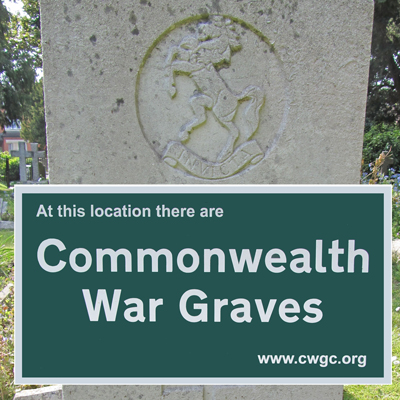
Joe Whittaker spoke to us about the Commonwealth War Graves Commission and their archives.
Fabian Ware and others became concerned about the numbers of casualties from the Great War who were buried in scattered cemeteries or unburied and on 21st May 1921 the Imperial War Graves Commission was founded by Royal Charter and the then Prince of Wales (later Edward VIII) was appointed President.
Fabian Ware became the first vice chairman supported by many of the top professionals of the day including architects Edward Lutchyns and Herbert Baker (who lived at Owletts, Cobham, Kent) and Nobel Prize winning author Rudyard Kipling.
There were three founding principles:
● Each person was to be commemorated on a headstone or memorial.
● The headstones and memorials should be permanent.
● There was to be no distinguishing between ranks.
The decision was made to bury the dead where they fell. This for some people was controversial, but at the time few could afford repatriation and the decision held.
Other decisions made were that the headstones should have a uniform appearance. A font was designed with concave letters to allow rain water to run away. It was decided that each stone should include name, rank, age and date of death plus up to 60 characters for words chosen by the families. The serried rows of stones in the bigger cemeteries are reminiscent of rows of soldiers marching
All the major cemeteries include a stone of remembrance which is topped with a cross incorporating a sword of sacrifice. In Ware’s words: “To some it is a Christian cross; to others the stone is irrelevant and the sword itself is the cross; and to others the artwork symbolises those who sacrificed their lives to the sword.”
The Commission cares for 23,000 memorials around the world commemorating 1.7 million casualties from the two world wars, from the British Empire 1914-1921 and the British Commonwealth 1939-1947. Casualties from other conflicts are not included. Casualties who died of wounds after returning to their home country are usually buried in local cemeteries. Very many village churchyards include one or more CWGC headstones which are cared for by the commission.
The workforce is mainly stone masons and horticulturalists supported by many volunteers but also a team who work to identify newly discovered remains as and when human remains are found, usually during building and construction works.
In addition there is much more information about the formation and work of the Commission on the CWGC website which includes a powerful database search feature to find the individual memorial to a serviceman who died in one of the world wars.
Report by Brenda Paternoster