
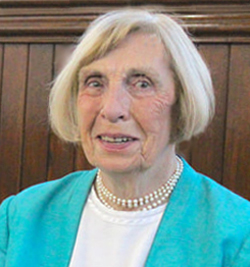
Lady Teviot gave us a fascinating talk about the beginnings of vaccination in this country with special reference to smallpox. She talked about the history of the process which started as variolation, where matter from a pustule (or variole) was scratched into the abraded skin of another person to provide immunity.
In 1721 Lady Mary Wortley Montagu introduced variolation into Europe after observing it in the Ottoman Empire, where her husband was ambassador and asking for her 2 daughters to be inoculated. In 1774 Benjamin Jesty, a Dorset farmer, tested the hypothesis that cow pox, a bovine virus that can spread to humans, could protect a person from smallpox and it proved effective. In 1796, the more famous Edward Jenner, inoculated an 8 year-old boy, James Phipps, with matter from a cow pox sore and two months later, checked that immunity against smallpox. This was the beginnings of a procedure that ultimately protected the whole world from a dreadful disease that had been with us since at least 1350 BC.
By 1840, the First Vaccination Act had been passed, making variolation illegal and freevaccination a requirement for all Poor Law Union occupants. Over the following years, 7 more acts were passed including the 1853 Act which made it compulsory to vaccinate every child in England and Wales by the time it was 3 months old. We might think that anti-vaxxers are a modern phenomenon connected with the Covid-19 outbreak but Lady Mary said there were many people who felt vaccination, especially compulsory vaccination was unsafe and were very frightened by it. In 1853 the Anti-Vaccination League was created and by 1867, because of a new Act making vaccination compulsory up to the age of 14, the Anti-Compulsory Vaccination League was formed. Individual cases, such as that of Mary Clark, who was so terrified of having her baby vaccinated that she drowned herself and her baby, highlighted the worry caused by vaccination. In 1885 Leicester had a demonstration against vaccination in which 80,000-100,000 people took part, carrying banners and an effigy of Edward Jenner. By 1896 a National Anti-Vaccination League was set up and the law was amended in 1898 to allow ‘conscientious objection’ to vaccination. Lady Mary gave us many more examples of people who claimed to be harmed by vaccination and occupations where employees were encouraged or forced to show vaccination certificates.
Nevertheless, vaccination against the smallpox virus has saved many thousands of lives worldwide. In 1980 the World Health Organisation announced that it was the first example of a disease to be eradicated across the globe. Lady Mary’s talk showed us that people were,and still are, suspicious of medical advances; human nature does not change as quickly as we’d expect.
-------
Report by: Lesley Smith Secretary, Deal branch, Kent FHS