
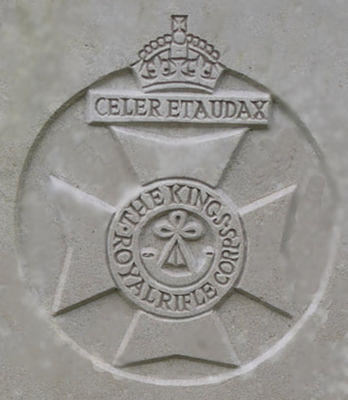
Andrew Richardson gave us a thoroughly entertaining, illustrated talk about his maternal Great-grandfather. Joe Shepherd was just an ordinary family man who had been like a father to Andrew’s mum. Luckily for Andrew, Joe and subsequent family members had kept the contents of Joe’s box marked ‘J. Hofman’ for well over 100 years; this comprised lots of photos and memorabilia, official and unofficial, from Joe’s life as a soldier.
Joe was born at Dundalk, Ireland but both of his parents were English; his father was serving there as a soldier. They moved back to London but both of his parents died and he was left to be brought up by an aunt. They didn’t get on, so Joe, lying about his age, signed up for the army as soon as he could and was posted to India as a rifleman. After serving in India, the British Government sent troops from India to the 2nd Boer War in South Africa and Joe served in the Kings’ Royal Rifle Corps. The conflict was much tougher than expected by the British; the Boers were thought of as simple farming folk but they had the latest artillery and rifles, so the battles were hard-fought. The conflict included the sieges of Ladysmith and Mafeking – Joe belonged to the Ladysmith Siege Club. He returned to Kakool, India with the Boer prisoners of war.
After returning to England, he moved to Folkestone to be near his sister Harriet and married Clara Pearson in 1908. By 1916, he had joined up again and trained at Queenborough on Sheppey in the 6th Battalion Kings’ Royal Rifles. By March 1917 Joe was on the Western Front and was amongst a list of men who were trained as ‘scouts’, one of the most dangerous roles for a soldier. He had retained a map with his own symbols drawn on the reverse, so very personal items from the war were kept in his box. In April 1917, the Germans made a tactical withdrawal and the British forces followed them up – Joe received a gunshot wound to his left arm, leaving him with major injuries, so was sent back to Britain. He arrived at Leeswood Hall, Mold, N. Wales to recuperate from his injuries. During their time there, soldiers drew naively charming pictures in an autograph book kept by VAD nurse Ada Hodgkinson; Joe had drawn two sketches, both dated October 1917 and signed Cpl Joe Shepherd, 60th Rifles.
After the war, Joe returned to Folkestone to work as an electricity meter reader and continued supporting his wife and four children. When the Second World War broke out, Joe couldn’t sign up for the Home Guard as his damaged left arm wouldn’t allow him to shoot so he became an ARP Warden - Andrew even managed to find a photo of Joe in this role.
Andrew had managed to follow his great-grandfather throughout his family life and his time as a soldier over three different wars. Luckily Joe’s memorabilia from his time in the services had been kept by successive generations and perhaps that should be a lesson to us all. Often it’s the minutiae of our relatives’ lives that can be fascinating to family historians and puts real flesh on the bare bones of official records.
Lesley Smith
Deal Branch Secretary, Kent FHS