
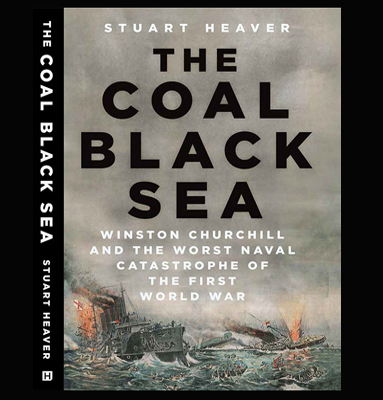
Book Cover
Stuart gave us a fascinating, illustrated talk based on his research about an incident that occurred on 22nd September 1914, 26 miles north of the Netherlands coast when 1,459 men and boys lost their lives during the sinking of three naval vessels.
Stuart first became interested during a visit to Westleton, Suffolk, when he looked at the village war memorial. His uncle Leading Seaman William John Potter was commemorated on the memorial as being lost on 22nd September 1914 on HMS Cressy; also lost was Stoker 1st class David Spindler on the same ship, on the same date. This intrigued Stuart and when he discovered the massive loss of life, wondered why he had never heard of this naval engagement before. Other WWI naval battles such as the Battle of Coronel were well knownwith the loss of 1, 660 men, the Battle of Jutland with the loss of over 6,000 men and the loss of ocean-going liners such as the Lusitania (1,198 lives) and Titanic (1,503 lives) were well-documented but Stuart had never heard of any engagement on this date.
From his research, he found that three ships HMS Cressy, Aboukir and Hogue had been sunk by a single ‘U’ boat, the U-9, captained by Otto Weddingen. They had been patrolling the ‘Broad Fourteens’ without any escorting destroyers when HMS Aboukir was hit by a missile fired by the German submarine. The captain assumed he’d hit a mine and asked the other 2 vessels to close in to pick up survivors; HMS Cressy and Hogue were then hit by torpedoes in quick succession and all three vessels were lost.
The sea turned inky black as far as the eye could see’ due to all the coal carried by the vessels to power their triple-expansion steam engines. The loss of life was reported at the time on the front page of the Daily Mirror and Daily Sketch and made international news in the Washington Times but then somehow seems to have been forgotten. It was also reported in the local papers and almost everyone knew someone who was lost in the incident. Two of the Penn brothers of Custom House Lane, Deal, Alfred and Louis Penn both served on HMS Cressy and were drowned; only their brother Hubert survived but was in the sea for two hours before being rescued. Two other sailors Wallace James Bailey (Cressy) and Thomas Snoswell (Hogue) were also lost and are commemorated on the Deal War Memorial and at Chatham. It was a social catastrophe with not only the grieving relatives left behind but families who had also lost the main bread winner, had no welfare state and no pension provision to support them, so much hardship was felt by these naval families.
Winston Churchill had been appointed First Lord of the Admiralty by Asquith in 1911 but had ‘never commanded as much as a rowing boat on a boating lake’. The war was not going well for Britain with the Goeben incident and the Siege of Antwerp so this loss of three armoured cruisers was not good for his career. Churchill described the ships as obsolete, their crews as ‘reservists’ and the commanding officers as ‘incompetent’ and tried to shift the blame, and anger from the public and the Royal Navy, away from himself and the Admiralty. Stuart investigated the fallout from the disaster, the formal Court of Enquiry and how the incident was ‘spun’ against the reputations of the officers and their actions at the time.
The book makes an intriguing investigation into primary source materials of the period – to find out any more, you must read the book!
Report by Lesley Smith, Deal Branch Secretary of Kent FHS