
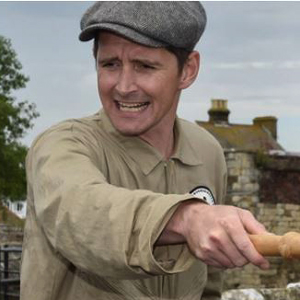
George was going to give us an illustrated talk on ‘Things that you never knew about Deal’s castles’ but instead gave us ‘Smuggling on the Kent Coast’ which was very engaging and entertaining. George, who started ‘The History Project’ in 2017 is a tour guide, giving historic walking tours in Deal, organising history talks at the Astor Theatre and visiting schools, giving immersive historical experiences (this involves dressing-up!).
Smuggling was a problem in Deal, certainly from 1730 to 1840 and was threatening the economy of the country. This period was the ‘Age of Sail’ but rowing boats, like ‘Guinea boats’ could cross the Channel in 5 hours and were much faster than Government clippers under sail. In 1784, one thousand soldiers were sent to burn every seaworthy vessel in the area to stop smuggling but even this didn’t finish the trade. Deal was a successful place for smuggling as the mariners had great local knowledge, knew which areas of sea were treacherous and had an offshore harbour due to the Goodwin Sands. Deal was also close to London, which gave it large markets for contraband goods and shingle beaches aided smugglers, as boats could be ‘beached’, then launched on the next tide.
The trade in smuggled goods from Kent started much earlier, certainly by the 12th century, when wool was taken out from the Romney Marsh to the Continent. The best quality wool in the world came from England while the best weavers lived in France and the Low Countries, so a tax was placed on wool to reduce smuggling. Smugglers called ‘Owlers’ operated in the dead of night and were not the loveable rogues portrayed by later generations. Criminal gangs muscled their way into the smuggling gangs and this was a major problem in Deal: in Kent, the Hawkhurst Gang was one of the most infamous. After the St. Bartholomew’s Day Massacre in 1572, many Protestants left France and settled in predominantly Protestant countries including Britain. Many settled in Sandwich and Canterbury and by 1665 about a third of Canterbury’s population were employed in weaving. Once Huguenots arrived to weave in England, the export trade in wool reversed and came back to this country.
George gave us many other stories including the ‘Battle of Botany Bay’ in 1769 when smuggler Joss Snelling lost 15 members of his gang, 9 who died of their wounds and 6 hung at Gallows Field in Sandwich and tales of Napoleon, who actively encouraged smuggling to reduce the amount of money coming into the English economy.
We also got some idea of how lucrative the smuggling trade could be. William Baldock of Petham, a member of the Seasalter Gang, died in 1812 leaving £1.1 million – this translates to the enormous sum of up to 200 million pounds in today’s money!
George gave us a very entertaining evening; I’m sure his talk on Deal’s castles would have been just as interesting. The History Project can be found at Deal Railway Station and is open Mon - Fri from 10am – 2pm. On Wednesdays, George holds sessions archiving East Kent Mercury newspapers, of which he has a considerable quantity.
Report by Lesley Smith – Deal Branch Secretary