
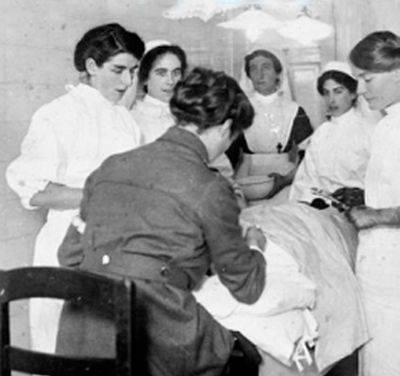
Pat Smith gave us the meticulously researched career of one of the lady doctors of World War One (Constance Mayer/Callender nee Scott) who died in Kingsdown and her remarkable journey, against much prejudice, to become a physician.
The investigation had begun when a friend of Pat’s, who was looking into GPs working in Canterbury, found that in 1919 there was only one female doctor, Dr Mayer (sometimes Maer) who was practising there.
The Medical Act of 1858 stated that all physicians, surgeons and apothecaries must be accredited and in 1859 the Medical Register was created. By 1876 medical registration was supposed to be without distinction of sex but as examinations were not required to be open to women, practically, women were excluded. Elizabeth Garrett Anderson initially trained as a surgery nurse, then after much private study managed, by a loophole, to obtain a licence from the Society of Apothecaries in 1865, to practice medicine. That loophole was swiftly closed to stop other women following her example.
Other pioneering women doctors included Dr. James Barry (born Margaret Ann Bulkly and adopting her uncle’s name) who masqueraded as a man, qualified in Edinburgh in 1812 and served as an Army doctor for years. Dr. Elizabeth Blackwell, although born in England, was the first woman to obtain a medical degree in the United States.
Constance Muriel Scott was born in Wakefield in 1878, educated at the Clergy Daughters’ School near Kirby Lonsdale and entered Cambridge University as a medical student. She trained in the London School of Medicine for Women and in 1902 gained a licence for practising in Edinburgh. Constance then moved to Stoke Newington and began training females as medical missionaries. By 1903, Constance had moved to the Punjab and was in charge of the 750 bed Womens’ Hospital of the Church Missionary Society; in this era women doctors could only care for women and children.
Constance Scott married Cyril Astley Mayer in Canterbury in1910 but their paths diverged with him enlisting in the Australian Imperial Force and Constance returning to the Punjab. During WWI women doctors were initially treated with distain; for example when Dr Elsie Inglis volunteered, she was told to ‘Go home my good woman and sit still’! As more male doctors went to the Front, the civilian population did not have enough medical care and women doctors were eventually allowed to take part in the war effort. In August 1916, Constance and 14 lady doctors embarked from Southampton bound for Malta, known as the ‘Nurse of the Mediterranean’ because so many soldiers were treated and convalesced there. Although the ladies were paid the same as the male doctors they had no uniforms, only travelled 3rd class and were banned from the Officers’ Mess. After Malta, she moved to Egypt where conditions were challenging with the extreme heat, dysentery and enteric fever. Dr. Maer and her female colleagues continued to complain about their status compared to their male counterparts, with their lack of uniform leading to their not being taken seriously, hence difficulty in maintaining discipline. Constance said ‘We need rank for our patients’ sake as we need to maintain discipline among 130 men. We need it for the sake of the profession as a whole, that no one section of it may ever be considered inferior to another.’
After the war, in 1920, Constance was awarded the OBE and in1922, the British War medal and Victory medal but her husband divorced her in the same year, for desertion. She returned to Cairo and remarried, retiring in 1927and returning to England 2 years later, when she settled in Ripple, then Kingsdown in Kent. In WW2 she worked with St. John Ambulance but came to a tragic end in 1948 when her bicycle was involved in an accident with a car near the Rising Sun, close to her home of ‘Overhill’.
Dr. Constance Callender was one of the pioneering women doctors who strove for parity with her male colleagues but the fight continued after her death. It wasn’t until 1957, well after WW2, that female doctors were commissioned like their male counterparts. Thanks to the dedicated research of Pat Smith, we were able to hear the fascinating life and career of a very brave and resourceful woman that most of us had never heard of before.
Report by Lesley J Smith
Next Meeting
Tuesday 11th December 2018 - Members' Evening
The Ancestor I would most / least like to meet! Members' Stories