
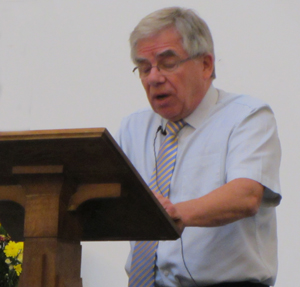
Peter Ewart’s talk entitled ‘Parish Registers: pitfalls, problems and perplexities’ needed ‘positives’ added to the alliterative list as he said, the subject does not focus entirely on the negative.
Peter started by saying that Parish Registers are the ‘Bread and Butter’ source for all family historians, therefore we should all be entirely familiar with what they look like. However, having been a genealogist since the mid-1970s, Peter can’t stress enough that we should not be totally reliant on them. They are as prone to fallibility as any other record out there. He felt that their fallibility has been compounded over the past 15 years or so as more records become available on computer. Whilst computers are a marvellous tool it is dangerous to research just online and only using indexes and transcriptions. He hoped none of us in the room this evening were using only online records as an alphabetical list can be up to 5 times removed from the source material of the parish register. The original compiler of the records could also have made mistakes. Peter urged us to look at the actual pages of registers. Handling the source material would, in an ideal world, be the best option because there can be clues on other parts of the page and register. However, due to constant handling most Parish Registers are now on film although you can ask the archivist if you could see the original register. They may allow it, especially if you can give them a valid reason.
Many researchers may not be able to read 16th/17th century handwriting in the early registers but you can teach yourself to read them without needing a palaeography course. The alphabet hasn’t really changed, just the formation of the letters, and there are several good books on palaeography which demonstrate alphabet letter formations during different eras. All archives hold such books so ask the archivist if you may use one to help you read the registers. There are also websites that have online courses, such as The National Archives, that explain old handwriting and how to read it.
Over several centuries there have been various pieces of legislation affecting parish records and to fully understand the Registers we need to appreciate what legislation was current for each of the eras of our research.
Pre-reformation entries were mainly used by the monasteries for inheritance purposes so focussed on prominent people.
1538 –Thomas Cromwell, on behalf of Henry VIII, issued an edict that the date of every single marriage, baptism (not birth) and burial (not death) that happened in the parish had to be recorded. Each parish was to obtain a chest in which to store the records and the chest MUST have 2 locks. However, this order was not followed to the letter in every parish in the country. The baptisms didn’t record parents’ names as they were not making records for family historians!
1558 – Elizabeth I issued a reminder to parishes that her father’s regulations of 1538 must be followed.
1598 – Elizabeth I decreed that every church must use a register book made out of parchment. Every item that had previously been recorded, from 1538 or at the least from the start of her reign, was to be transcribed into the new parchment register and this book was to be used for all future records. Unfortunately, the original records were often scrapped. Most Tudor baptism entries did not record mothers’ names and often both parents were omitted, either because they were not specifically required or because of human error. Also, copies were to be sent annually to the Bishop or the Archdeacon which may give family historians a second bite of the cherry, with regards to parish records. Canterbury, with the best set of Bishops Transcripts (BTs) in the country, was already copying registers to the Bishop from the 1560s. Each year’s BTs occupied just one sheet of paper, so were easily misplaced or lost. The old Julian calendar started on 25th March, not 1st January, and so care should be taken to check for annual continuity. Although, PRs and BTs should exactly match each other, they often don’t but how do you know which is correct? Peter suggested, lacking any corroborative evidence, that information on the original Parish Registers should be considered the correct information but there may be exceptions to this.
1604 – James I & VI gave a reminder to parishes about the Tudor orders and particularly that registers should be completed within 7 days of the events. The names of both parents, and for marriages, the full names of both participants, should also be recorded. Parchment copies were to be made and signed by the Minister and the Churchwardens. Another copy of the records was sent to the Archbishop, as well as the Bishop, and transcripts were generally all by the same hand, not by different incumbents.
1641 - Charles I decreed that registers should be made of Vellum (calf’s skin).
1645 – Charles I instructed that the date of birth, date of baptism and parents’ names were required for baptisms. Burials should record both the date of death and date of burial. This instruction only lasted for a short period as the king was beheaded.
1649 to 1660 – the 11 years of the Interregnum were the worst time for PRs as they were not well kept, if at all and the records are now known as the ‘Commonwealth Gap’ because of this. All parish records were removed and handed over to secular authorities but Peter said don’t give up, you will find other documents such as wills, which still exist for this period. Secular 'Registers' were introduced and Peter remarked that this was a confusing job title as it related to a person not a book. Hence, he would continue this talk by referring to them as 'Registrars' as we would know them today. Banns were to be called in a market place, and if a marriage took place (not always the case it should be remembered) a JP would conduct a civil ceremony in a secular building. Most registers are a ‘dog’s dinner’ in this era with spaces, gaps in dates, missing entries and not advising the authorities. However, for a very short period, considerable additional information was given in marriage entries.
1660 – Charles II, the Restoration of the Monarchy. Although Charles II dated his reign from his father’s death in 1649, he was not in power until 1660. He abolished the edicts of the Commonwealth period, including civil banns and marriages, returning the recording of significant life-events to the Church again. People now came to ask for the baptisms, marriages and burials that had taken place during the Interregnum to be recorded in the parish registers and so, using memories of the occasion, they were inserted into registers where possible and you may need to check most of the Register to ensure you haven't missed one.
1662 – Charles II introduced a new Book of Common Prayer which Clergy must follow. Baptisms were to take place on Sundays and Holy Days so that the event took place in the presence of as many parishioners as possible. Latin was no longer to be used in church. Private baptisms (at home not in church) suggest that the child was unwell; usually they were received into the Church a few weeks later.
1666 and 1678 – More regulations meant that all burials were to be wrapped in English wool, to boost the country’s cloth industry; exceptions to this rule were paupers and plague victims. An affidavit had to be handed to the clergyman and a fine of £5 levied if the rule was flouted. The rich tended to continue burying in linen or silk and paid the fine, almost like a status symbol. Half of this fine went to the clergy and half to the informant which meant they only needed to pay half the fine if they reported themselves! 'Burials in Wool' registers still exist for some parishes alongside the traditional Burial Registers.
1690 – A tax of 3d to make an entry in the parish registers was introduced but lasted only a few years. Non-conformist births were also supposed to be entered.
1711 - Legislation introduced lined pages in Baptism Registers, occasionally pre-printed. This makes it easier to search down pages of the Registers. Peter warned it was not good practise to skim through pages, so slow down and you may spot more important clues in unsuspected entries.
1733- No more Latin entries, all to be in English, although you may still find a sprinkling of Latin terms which you should not dismiss as they may aid your understanding of the entry. Often information was added like age, where they’d come from or what they’d died of but this wasn’t required and seemed to depend on the incumbent.
1751/52 – change of calendar, from Julian to Gregorian, to fit in with the rest of Europe. Scotland was not affected having long adopted the Gregorian calendar. But, for the first time in England and Wales, New Year’s Day is on the 1st of January, rather than the 25th March as it had been in the time of the Julian calendar. Also 11 days had to be lost to synchronise the calendars. Hence, in 1752, there are no dates between the 1st and the 13th of September.
1754 – Lord Hardwick, who Peter called ‘Our Hero’, introduced laws against clandestine marriages. Before this some clergy had married anyone, not checking who they were and where they came from. This ended informal marriages and ensured participants in a marriage were residents of a parish for a few weeks before the ceremony. Registers had pre-printed certificate-style entries with fewer entries on a page. More information is included such as witnesses who signed the Register. Witnesses were usually someone of the same generation as the couple so they were more likely to be alive in the future to vouch that the marriage had taken place. Hence witnesses were more likely to be siblings or friends of the couple, rarely their parents. Banns are now being read on 3 Sundays before the marriage: not necessarily consecutive Sundays but do not presume that a marriage then took place, as some did not. Peter quoted an occasion in Cranbrook where the Banns were called but the husband-to-be ran away before the marriage could take place, leaving the woman to give birth to a child out of wedlock.
Remember that Baptisms are not a date of birth and that people may be baptised at any time in their lives; often families did ‘job lots’ with all the siblings being baptised on the same day. Sometimes parents were also baptised on the same occasion as their children and clergy tended to round up those who had not been ‘done’. Baptisms could take place at home, especially if the child was likely to die, in which case you may see an entry to that effect such as ‘shown or presented in church’ where the baptism details were to be recorded. Baptism should only take place once in a lifetime although it’s not impossible to find two entries for a variety of reasons.
1783 – Stamp Act charged 3d for each Baptism, Marriage and Burial entered in the Parish Registers but it was unpopular and was rescinded in 1794. Paupers, receiving parish relief, were exempt and you may find a ‘p’ beside the entry to show why a fee had not been collected. By the 1780s there was an increase in non-conformity.
1812 – George Rose’s Act provided for pre-printed registers for baptisms and another for burials from 1st January 1813. They contained more information on abodes and occupations. BTs were still being recorded.
1837, 1st July - The start of Civil Registration in England and Wales. Annual returns for Marriages were no longer sent to the Bishop and after some decades (varying from parish to parish) returns for Baptisms and Burials faded away.
Summing-up, Peter reinforced his tips, warnings and reminders.
● Assuming an entry MUST be the one you seek is bad research.
● Always use original sources and more than one is a good research technique.
● Baptism of the 1st child was often traditionally held in the Mother’s parish regardless of where the marriage took place and where the couple lived subsequently.
● Some Burials were never entered in the register such as: Babies who were often placed in with any burial taking place at the time OR unknown bodies washed up on the shore etc.
● Check the habits and pattern of the person making the register entry, terminology they use etc. which may help you decide if the record is for an infant or an adult.
● Do you know the parish boundaries? You can’t search properly if you don’t check the surrounding parish registers. People often attended the nearest church to home even though it wasn’t their parish church.
Most important to remember is that none of these records were created for the Family Historian’s benefit !
Next Meeting
Due to COVID-19 pandemic, and current guidelines regarding mixing with other people, Deal and District Branch have suspended their activities. We hope to return to our normal schedule of meetings in the not too distant future.