
Viv gave us an immensely enjoyable, illustrated talk about Henry Fothergill and his entrée into polite Victorian society. A series of diaries written by Henry from 1860 until his death have been transcribed by
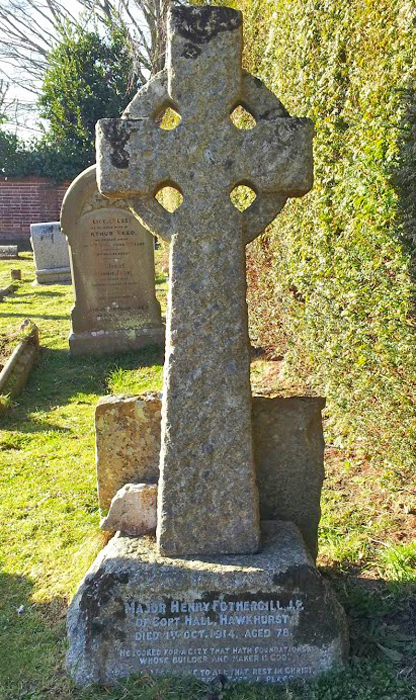
of Copt Hall Hawkhurst Kent
volunteers at Glamorgan Archives; Viv was particularly interested in the last 30 years of his life in Hawkhurst, Kent which gave a detailed window into his and his wife’s social life.
Henry travelled widely around the world from 1867 for 10 years before settling in Hawkhurst in 1877. He bought himself a commission in the 4th Battalion of the Essex regiment, so he was Captain Henry Fothergill when he married Edith Russell Horwood in 1877, the daughter of the vicar of Maldon. He took a lease on a large property, Copt Hall, in Hawkhurst, for himself and his family, in August 1880. The area had a considerable quantity of very wealthy families, some with many staff, and Henry set about entering the local social circle. He started by visiting the local vicar, Canon Jeffreys, who probably made some introductions on his behalf. Over time, he gradually visited many of the large houses in the area and his visits were returned. Henry seemed to be a very energetic person being an early riser, cycling long distances and playing lawn tennis and billiards; eventually Copt Hall had 4 tennis courts. Sporting activities such as lawn tennis and billiards were the social glue that held these upper class communities together, along with garden parties during the summer months. By 1885, Henry was a Major in the 4th Battalion Essex regiment and, in addition, had joined the local hunt and taken up ice-skating. The local church was also important to him and his family – to see and be seen by the local community and his peers.
Viv gave us an insight into many of the wealthy families and their houses that Henry and his wife were familiar with. I’ll only give details of a few:- Lillesden House, with a huge staff of 16 servants, was owned by Edward and Caroline Loyd. Edward was a banker, J.P. and High Sheriff of Kent – the house has since been converted into luxury apartments. Risden, an old estate, was inherited from his father by George French Jr. and his wife Anna. George French Jr. was a farmer of 250 acres and a magistrate – he had also inherited two sugar plantations in Jamaica and in 1833 when slavery was abolished, his father George French Sr. was compensated by the Slave Compensation Commission for the loss of 377 slaves and received £8,022; the wealth of this estate obviously came from a source we find unacceptable today. An unusual story concerned Augustus and Sarah Springett from Ashfield Park, Horns Hill, Hawkhurst. Augustus was born with the surname Pout but took his wife’s surname on their marriage as a condition of her father’s Will. Augustus trained in medicine and surgery and was awarded an MB in 1857(London), MRCS (London) and LSA (King’s Coll); by 1881 he was no longer practising medicine and sadly died a year later at only 50 years of age.
During his lifetime, Henry Fothergill even gathered together a private animal and bird collection at Copt Hall, including kangaroos, rheas and cranes. He was a member of the Amateur Menagerie Club and at his death in Oct 1914, he left £84,436/ 14s/ 5d.
The discovery of his diaries and the painstaking research that it inspired gives us an insight into a group of seriously wealthy people in a small area of Kent. Viv had provided the social setting of a very ‘comfortable’ Victorian life in Kent and peopled it with all of Henry’s social circle.
Report by Lesley Smith
Deal Branch Secretary Kent FHS