
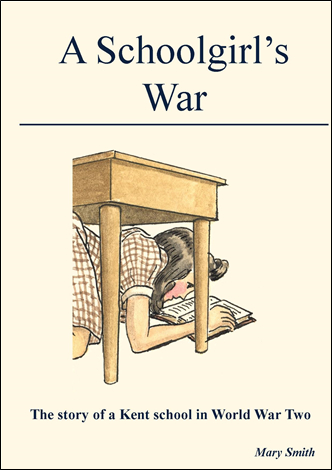
book cover
This talk was given to Canterbury Branch in October 2019. But the members of Deal Branch were able to hear an updated version as in July 2020 the school were able to gain access to the newly discovered tunnels at the front of the school.
Plus the current pupils are producing a slightly different account of their school during Covid19 with the girls paintings and pictures telling the life of the school during a pandemic.
Mary Smith, former head teacher of Maidstone Girl’s Grammar School, gave the branch a fascinating glimpse of life in the school during WWII in her illustrated talk, ‘ A Schoolgirl’s War: The story of school life in WWII’. An excellent speaker Mary illustrated her talk with photographs and images from her book with the same title.
The finding of a War Diary coupled with the unblocking of the staircase to the school’s WWII air raid shelter started Mary on her retirement pursuit to document the School in wartime. During her research Mary had tracked down 53 ‘Old Girls’ and visited many of them to take oral history of the recollections of the war years.
The School's Art Teacher, Helen Keen, had kept the War Diary which had been stored in the school’s archive cupboard. It was full of interesting sketches and paintings documenting the life of the girls, teachers and ancillary staff at Maidstone Girl’s Grammar School from 1939 - 1946. Some pictures were a humorous look at what might have transpired if some of the illogical wartime regulations imposed on schools had been carried out to the letter! The War Diary has been shown to experts at the Imperial War Museum who said they had seen nothing comparable.
The story starts in September 1938 when the girls arrived in their brand-new school building with the hope, as one wrote, of “peace, happiness and sunshine”. This was short lived with the unrest in Europe in that year. Girls were told that in the event of war they were not to come to school but to wait at home for instructions. In the Summer of 1939, the eldest girls were called on to help with evacuees arriving in Maidstone. Warren School Plumstead arrived with their teachers having been assigned to share Maidstone Girl’s Grammar School. A strange decision as Maidstone was then a garrison town and on the flight path from the coast to London. Mary showed photographs of the devastation from many air raids that Maidstone suffered during the war.
Mary said virtually every Kent school once had tunnels built as shelters but many were filled in or dug up after the war. No other school’s wartime shelter has been found in to date. When war broke out there were of course no air raid shelters and since large numbers of children were not permitted to congregate without such a facility pupils could not attend school. So, the girls were told to wait for a postcard to tell them on which morning or afternoon they were to come to school to collect lessons to do at home. Shelters were completed after the first years of the war and girls were able to attend school daily as usual.
The Shelter was nick-named the ‘trenches’ by the girls and were built on lines of the zig-zag trenches of WWI so that a direct hit would not blast through the entire shelter. Each section was big enough to seat a class of 30 girls. At first, they were poorly lit by lanterns but they eventually had electricity for lighting although these were still very dim. The trenches were airless, cold and damp with puddles often forming on the earth floor. They had Elson toilets but no heating. Hence during the winter, girls had to come with extra clothing to wear in case they had to use the shelters. The shelters were noisy as classes continued whilst they were in the shelters and teachers had to project their voices to be heard. Often there would be a battle going on overhead too. The shelter’s wooden walls were used as blackboards and the remains of lessons still adorn the walls today. When Doodle-bugs began arriving over the area there was no time to get the school into the shelter so they had to hide under their desks.
Despite being surrounded by two railway lines and a barracks the school was not hit by enemy action although most of the surrounding area was.
The school had two shelters built one at the front of the building and one to the rear. It had been thought that the tunnels in front of the school had been filled in but a historical tunnelling group asked if they could look for what remained of the tunnels at the front. Although they found that the entrances had been filled in the tunnels were still intact under the ground and possibly in a better condition than those at the rear. At first the tunnels needed to be examined to ensure they were structurally sound but in July 2020 the school were able to gain access to the newly discovered tunnels at the front of the school.
Today, as WWII is part of the current curriculum, the tunnels are being used for Primary Schools to have a better understanding of school life in the war. They hold re-enactment lesson starting in a conventual classroom above ground. Then an air raid siren is activated and the children are hurried into the shelters where their lessons continue. They are also given a typical wartime lunch cooked in the school’s kitchens.
This talk was most engaging and can be recommended for all age groups.
The book, ‘ A Schoolgirl’s War’, that resulted from Mary’s research is available from Maidstone Grammar School and may be purchased by mail.