
Eglise Protestante Française de Cantorbéry
The French Church Canterbury Cathedral
Michael Peters was back by popular demand to lead the 2011 outdoor meeting; Canterbury branch members having so thoroughly enjoyed his 2007 walk on the same subject. On both Walks we were lucky with the weather as heavy rain gave way to a beautiful evening.
Michael's Walloon ancestors were the De la Pierres; a branch of which were amongst the first families to settle in Canterbury. He said we should not forget that it was the Walloons who came to Canterbury first, fleeing from their homeland in the Low Countries, and were later joined by the Huguenots.
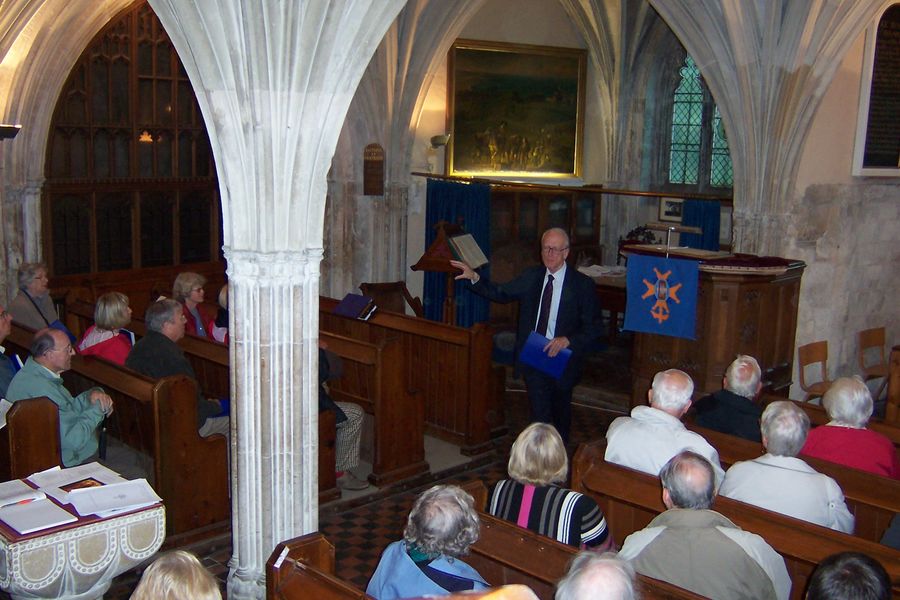
We met in The Cathedral Precincts where Michael started his tour by taking us to visit his church in the Black Prince Chantry in the Crypt of Canterbury Cathedral. His church: Eglise Protestante Française de Cantorbéry [The French Protestant Church of Canterbury] has met in the Cathedral crypt since the reign of Elizabeth I. Walloons were French speakers and their services are held in French under French Calvinist rites. We were told that all are welcome to attend the Sunday service at 3pm.
Michael began by introducing the historical background leading to the arrival of refugees in England in the sixteenth and seventeenth centuries. Sometimes known as 'strangers' or 'alien strangers' it was not a derogatory term as in those times a 'stranger' was anyone who wasn't from your area and 'alien' was used much as we use 'foreigner' today.
This was a most complicated period of religious upheaval in Europe which was put wonderfully succinctly by our guide. The origins of French Protestantism can be traced back to the 13th century and the marriage in 1284 of Philip the Fair of Flanders, to the Infanta Joanna, of Spain. By this marriage Philip became Philip I of Spain. Joanna and Philip's grandson was Philip II of Spain and inherited Portugal as Philip I of Portugal and Flanders as Philip III of Flanders. He was very much against the reformed religion and gave the governorship of the Low Countries to his zealous Catholic General; Fernando, Duke of Alba. Under Alba's extreme regime Protestants in the Low Countries were given no choice but to convert or die.
Soon French speaking Walloons managed to escape the Duke of Alba's extreme regime and during the1570s settled in Sandwich joining Dutch refugees from a neighbouring state of what is now The Netherlands. Sandwich couldn't accommodate so many refugees and asked that the French speaking Walloons should be found other accommodation. As the Dutch refugees already had a charter granted by Queen Elizabeth I they were allowed to stay in Sandwich.
In 1576 the Mayor of Canterbury offered 100 vacant houses in Canterbury to any who were weavers if they would make cloth in the city; and he even stated which cloth he wanted made! Many of the Walloon ‘strangers’ were woollen weavers of the highest quality and brought prosperity to a city suffering financially. Just a few decades before in 1538 Henry VIII had ordered that the the shrine of St Thomas Becket and other saints in the cathedral should be dismantled which hastened the demise of pilgrimages to Canterbury.
After the talk in the French Church Michael led us on a city walk covering the many places associated with the strangers. Our first port of call was in Turnagain Lane off Palace Street. Here we were shown what is probably the last original example surviving from the weavers' heyday of a long row of upper windows providing natural light for a large weaving room. A similar set of windows may be seen at the rear of this building giving the upper floor natural light throughout the day.
On the corner of Palace Street and St Alphege Lane is the now redundant St Alphege church.. It is now used by The Kings School. Shortly after arrival the Walloons were granted permission to share the church with the local St Alphege parishioners; with services for each community held at different times. But before long their numbers required a larger church and they were given the Western Crypt in the Cathedral.
The 'strangers' policed their own community and Michael showed us how they had drawn up 'quarters' on a map of Canterbury which defined where their 'police force' was to patrol. This proves that they did not all live in St Alphege parish as some people have presumed. Anyone behaving badly would be taken before the French Church's Consistory Court tried and punished; at worse they could be asked to leave the community and the city. Records of the French church's Consistory court dating from the sixteenth century are still housed in Canterbury Cathedral Archives.
Blackfriars Rectory - once part of the precincts of Blackfriars Monastery three sides were destroyed in the Reformation and the reaming buildings were rented by the crown to local weavers.
Standing on The Friars bridge the rear of Blackfriars Refectory could be glimpsed behind the trees on the right bank and the lovely building on the opposite bank is the Dominican Priory; once the guest house for Blackfriars Monastery The river here was once used for the fulling [stretching woollen cloth into shape and size] and dying of cloth. The Strangers used the Refectory as the Cloth Franking Hall. This was where the finished bolts of cloth were checked for quality and assessed for tax. The Refectory is another ancient building in the care of The King's School and is used by their art department.
In the High Street the building with pink pargeting known as Queen Elizabeth's Guest Chamber was formerly the Crown Inn. The date 1573 inscribed on the building refers to the visit by Hercule-François, the Duke of Alençon & Anjou, who stayed here whilst courting Elizabeth I, during her visit to Canterbury. The Queen stayed in the Royal Palace in St Augustine's Abbey. The former Abbots had been refurbished for Henry VIII and a new wing built for his honeymoon with his fourth wife Anne Of Cleves. Michael explained that Hercule-François' mission was doomed as his brother King Charles IX of France had orchestrated the St Bartholomew Day massacre the year before. Plus there were religious and age differences as Catholic Hercule-François was only 18 and Protestant Elizabeth was in her mid 40s! The Duke's courtship continued on and off for 11 years until his death in 1584. An old folk song is said to have been rewritten to poke fun at the situation. Although the words have undoubtedly been altered since we know it today as, 'A Frog he would a wooing go'. There could be some substance in this folk tale as it is know that Queen Elizabeth did call Hercule-François her little frog; because he had once given her frog ear rings!
Further along the High Street at number 39 High Street, Michael told us that here the Misses Philpotts and Holmes established a weaving school in 1896. It was to give employment to poor girls. In 1899, the school moved down the road to the house next to Kingsbridge called 'The Weavers'. The name 'The Weaver's' dates from when it was a school and museum and despite both closing in 1914, at the outbreak of WWI, the name has stuck. It is said to have once been the home and workshop of John Callaway; an eighteenth century Master silk weaver. Many visitors believe its the only building associated with weavers in Canterbury, not knowing that once their numbers were estimated at over 3,000 making up a third to a half of the city's population.
Leaving the High Street Michael ended his tour in Solly's Orchard next to the Dominican Priory with the Blackfriars across the river. Michael told how his Huguenot ancestors, the de la Pierres, set up home at the Blackfriars, and helped other Free Churches by allowing; Anabaptists. Unitarians, Christian Scientists, Methodists, Baptists and Quakers to use the refectory, or the chapel which had once been next door.
Report by Tricia Baxter