
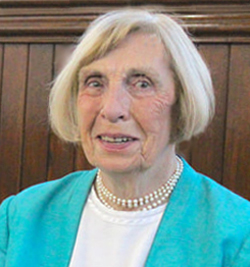
Lady Teviot began by given some, often amusing, examples of information contained within churchwarden’s presentments. The churchwardens were responsible for the general upkeep of the church building, the collection and non payment of church rates and the maintenance of the moral tone of church attendance. Examples of these are sometimes found within the records kept by the Churchwardens and may relate to ordinary people within the community.
Lady Teviot next turned to the Protestation oaths of 1641/42. All men over the age of 18 were required to take an oath of allegiance to the Protestant religion during this turbulent time in English history and some counties have an almost complete survival of these documents which can be accessed via the article 'The 1642 census' in Lost Cousins newsletter . The documents also record the names of overseers and wardens, and sometimes also list recusants who refused to take the oath.
Street Directories may cover areas where your ancestors lived. The University of Leicester hold no less than 689 directories, dating between the 1760s and the 1910s, including at least one directory for every English and Welsh county for the 1850s, 1890s, and 1910s. The collection can be accessed on the University of Leicester website: Historical Directories of England and Wales, as well as via Ancestry. County Libraries will also hold collections of directories local to their area. Those with a particular interest in London ancestors should seek out Holden's Triennial Directory of 1805-1807 for names of those connected with trade or industry; coverage widened in later issues to include major industrial centres.
Manorial documents are also worth looking for, particularly if your ancestors were Customary Tenants, holding manorial lands by customs. The speaker recommended seeking out the book 'Manorial Records' by Paul Harvey, for detailed information. From 1066 to the Eighteenth Century, the Manorial system shaped the lives of the rural population After 1733 , an Act of Parliament enforced the use of English; before this, they will be in heavily abbreviated Latin. The Records are the only source to find the transfer of copyhold land from person to person, by sale or inheritance. The Manorial Documents Register is available to search on the National Archives website
Coroner’s records are useful, although these were the property of the individual coroner. As there was no requirement for them to be deposited, their survival rate is very low. However, the details were often reported in local newspapers of the time, and the press reports were usually far more detailed than the Coroner's Report itself. Death due to accidents were common, especially connected to water; the speaker gave an example of a child of two who died after drinking boiling water from a kettle.
Gamekeeper’s deputations, dating from 1710 onwards, are indexed in some counties and often mention details about the gamekeeper’s themselves. Sometimes yeomen, weavers, butchers, even labourers were recruited as gamekeepers and moved estates frequently. The appointments were registered by the Clerk of the Peace, and the records were collected annually so it is possible to trace the movement of a gamekeeper from estate to estate, sometimes over several decades. The records are a good source of individual names, as well as their previous occupations.
Inquisitions Post Mortem held at The National Archives. Dating from the 1236 to the 1660’s, they record the owners of property held by the crown and were drawn up when one owner died, in order to determine their heirs and any income and rights owed to the Crown. The Crown held the property until the new owner made a payment, known as a relief, to acknowledge their new occupation. The heirs could be a single son or daughter, or a number of daughters; sons were not allowed to jointly own Crown land. Heirs could have their land held in wardship should they be under age; Lady Teviot gave an example from 1566 of one Elizabeth Gaston, whose uncle, George Gaston, held the lands on her behalf as she 'has been an idiot of weak mind from her birth'. However, Lady Teviot suspects he was giving the impression that Elizabeth would not be able to maintain the land in order to gain control years before he would inherit. County record societies have indexed many of the records, and partial indexing is searchable on Discovery. Many records will still need to be viewed at the National Archives.
Lady Teviot also mentioned records of local charities; a couple of London examples included the Fry guide to London Charities, dated 1917, and the London Female Guardians, who protected fallen women, and prepared them for trades. The Gentlemen's Magazine was the first periodical, published between 1731 and 1922; the magazine can be searched online up to the year 1868. The Old Bailey Online, 1674-1913, is a very name-rich resource, listing witnesses as well as criminals, and indexes for specific trades are worth searching for online.
Report by David Wood, Canterbury Branch Chairman