
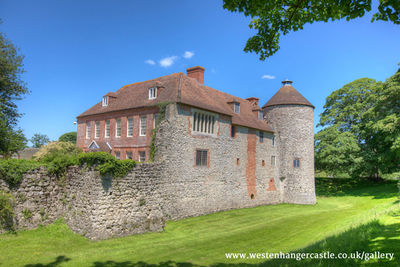
Our speaker Terry Whitling, a local historian, is descended from one of the owners of Westenhanger Castle. His presentation 'The Road to Jamestown' with images was researched on both sides of the Atlantic for this evenings talk about another owner of the castle and his connection with the first English settlement in North America. He started with reminding us that 2007 was the four hundredth anniversary of the first settlement at Jamestown. However, few will know of its connections with Kent and in particular with Westenhanger Castle.
Thomas Smythe, one of Queen Elizabeth I’s customs collectors moved to Westenhanger Castle in 1555 with his wife Alice. Eleven of their thirteen children were born at Westenhanger including their son Thomas born in 1558. The junior Thomas Smythe spent his early childhood at Westenhanger Castle before being educated in London at Merchant Taylors. He went on to become a wealthy Merchant in his own right and was wealthy enough to finance several Elizabethan international trade ventures. He was one of the founders of the East India Company becoming its first Governor and also set up the Virginia Company of London, the company which was to be involved with both early settlements in the New World; Jamestown in 1607 and the renowned Pilgrim Fathers in 1620.
In 1604 he became Sir Thomas Smythe when he was knighted by King James I and that year he became Ambassador of Muscovy. Whilst undertaking his ambassadorial duties he first met Captain John Smith who was then a slave of the Turks. Thomas Smyth provided money which enabled John Smith to escape captivity and return to England. John Smith was to play a part in the Jamestown venture.
To stock three ships the Godspeed, Discovery and Susan Constant on the first voyage from London to the New World was to cost the Virginia Company £30,000. But there was a shortfall of £18,000 and Sir Thomas made up the shortfall from his personal fortune. It was also Sir Thomas who personally selected from amongst the settlers the councillors who were to govern the new colony. He gave their names in a sealed order to Admiral Christopher Newport who was not to open it until they reached the colony. These councillors were instructed to elect one of their number to be President and Captain Edward Wingfield was chosen. Unfortunately, due to the hardships he was to become the scapegoat and was sent home to England to face charges.
In 1606, (14 years before the Pilgrim Fathers left England) the Jamestown expedition set out flying the Union Jack. This was one of the first occasions that the new flag had been flown having only just been fashioned. Unfortunately the three ships only got as far as the Downs off Kent when winter storms held them there for 6 weeks. This depleted stocks and an unscheduled restock had to be made in the Canary Isles. Of the 105 settlers, reputedly all male, who left Blackwall one died in the West Indies but the rest made it to Chesapeake Bay. However, they very nearly gave up on the final hurdle as reaching Cape Henry a suitable landing place eluded them. Eventually they found a suitable place and the settlement which was to be Jamestown was started with a fort; whilst the settlers lived in tents. Meanwhile, Captain John Smith set out to explore the River James and map it.
However, when the first supply ships returned the following year there were only 35 settlers left. A couple had died from wounds after skirmishes with the native population but a far larger number had succumbed to strange symptoms, possibly Malaria, due to the swampy Chesapeake Bay.
In 1610 a ship landed 57 women as it was not the done thing at that time to marry native women; John Rolfe’s marriage to Pocahontas being extremely rare. John Rolfe is credited with starting the tobacco industry in Virginia in 1612.
Street children, as young as 10, were shipped out to start a new life; but in truth they were little more than slaves. In 1619 the first Black African slaves arrived, originally from Angola they were exchanged for supplies.
In 1994 when Archaeologists came to survey the site it was thought that the first fort had been washed away by the James River. But perseverance by one archaeologist proved fruitful when finds of English Pottery started to turn up. Today close to the site of the Jamestown Settlement are replicas of an Indian Village, a Fort, church and other buildings of the era. Whilst at Westernhanger Castle is a replica of the Discovery.
Report by Tricia Baxter