
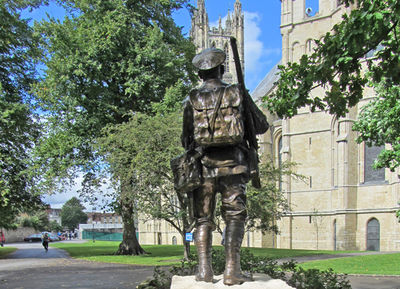
In his talk The Buffs in the Great War, 1914 -1918, Michael Miles started by reminding us that our local Regiment, The Buffs, is one of the oldest in the country founded in 1527 but unfortunately they were disbanded earlier this year (2013). Michael said that with almost six centuries of existence he could not do the subject justice if he tried to relate such a long history in one talk. Therefore, he would be speaking tonight about a short period, the First World War, a significant four years in the regiment’s life. He would also include avenues of research family historians might use when tracing Buffs ancestors who took part in this war.
In the summer of 1914 The Buffs strength was 5 Battalions. A full Battalion contains approx. 1,000 men. The 1st and 2nd Battalions were regulars and as such experienced troops. They were immediately recalled from India where they had been serving since 1905. The Territorial Battalions 4 and 5 were sent by Lord Kitchener, who never rated territorials, to India to replace them.
The 3rd Battalion was probably not up to full strength at the outbreak of war; its purpose had been to supply new recruits to the 1st and 2nd Battalions. Recruiting a new army at the outbreak of war saw a 6th Battalion formed. The recruiting drive led to the need for more officers with experience. Regular sergeants were commissioned as officers, whilst existing officers were promoted to the next higher rank.
Before conscription came in employers encouraged their workers to join up forming Pals regiments made up from men who worked together. In Kent WH Cory the Coal Merchants encourage his work force, mainly manual workers such as stevedores, to volunteer. He guaranteed to keep their jobs open for them during the war and 250 men joined plus his son who became their officer. As D Company 6th Battalion, The Buffs they were soon known as The Cory’s. Michael showed us a photograph of these men dressed in civilian possibly on the day they were enlisted.
Michael went on to outline several incidences in The Buffs were involved with in the Great War. Some futile where a senior officer not at fault was recalled and made the scapegoat. Some actions had been illustrated by Fred Bennett a well-known cartoonist who served with The Buffs. One depicted a a morale boosting picture of the action when 19 men of The Buffs held off a thousand Germans at the village of Radigan, whilst covering the retreat of a French regiment.
By the time the 8th Battalion was formed they had ran out of uniforms. He showed a photograph of a section in old uniforms which were dark blue and not liked by the men.
The Buffs only VC in WWI was Corporal William Cotter. He continued to control his men despite having his leg blown off and being severely wounded. He later died in hospital but not before being told that his efforts had earned him a VC. Michael read a tribute written by a nurse who attended him commending his outstanding courage during the time she nursed him.
Michael finished by saying that in WWI, 1,351 officers served of which 23% were killed, whilst of the 29,232 other ranks 19% were killed.
Amongst questions posed at the end was: “Why were they called The Buffs?” and the origin of “Steady the Buffs”. Buff was at one time the colour of the cuffs on their uniforms. Michael apologised for giving the more correct but less romantic account to the latter question. The Buffs were serving alongside another regiment whose officer only wished his orders to be carried out by his own men. He thus said the memorable phrase to stop The Buffs also acting on his orders.
Sources mentioned in the talk:
Tracing Officers - Army Lists at TNA and the National Army Museum seniority for promotion and in the index regiments.
Regimental Journal – The Dragon a monthly publication - not indexed but is still a good source of articles and stories about the men of all ranks.
Howe Barracks Library – is to be housed at the University of Kent and once catalogued will be made available for all.
The London Gazette – available online
Medal Record Entitlement – British War Medal Roll – Codes of War Medals all held at TNA
War Diaries, Battalion and Brigade – held at TNA
Tricia Baxter