
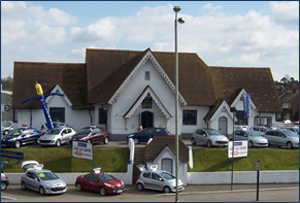
The Parochial School of St Mary Bredin Canterbury opened on 16th June 1856. It was built on one of the mounds that lie just outside the city wall at Rhodaus Town. The school closed in the summer of 1940, shy of its centenary by 16 years. The pupils were relocated to Wincheap Temporary School in Wincheap Grove, off Castle Street. The Temporary school, the Church and the boys wing of Wincheap School, Hollow Lane became casualties of the Baedeker Raids in 1942. The destruction of the temporary school and the church may be the basis of the statement about St Mary Bredin School in the Archives catalogue: 'This school was destroyed in the blitz of 1 June 1942'. Wincheap Grove once followed the line of the city wall by the Norman castle and was lost in the 1970s when the Rheims Way was built.
The Parish
The parish of St Mary Bredin covers 756 acres from The Parade, inside the city walls, out to the bounds of the parish of Nackington St Mary. It is bounded by the Canterbury parishes of St George, St Martin and St Paul, St Margaret, St Mildred and Thanington St Nicholas. There were two churches dedicated to St Mary Bredin opposite Gravel Walk in Rose Lane. After the second church became a casualty of the Baedeker Raids a third St Mary Bredin church was built in the Old Dover Road in 1956.
The appendix ‘Bredin’ is Saxon for wood of which the first Norman church was constructed. Hasted refers to the church as being known by people as ‘Little Lady Dungeon’ because it was the smallest church dedicated to St Mary; and said that its location was near ‘... to the Dungeon, or Dunjill’.
The First St Mary Bredin School
Before the building of the second church 1867 and the Education Act of 1870, it was recognised that there were many poor children in this parish who needed schooling. A Day-school was set up about 1851 ‘...By the zeal and perseverance of the late incumbent (the Rev. Vernon G Guise), aided liberally by the parishioners.’ It catered for around 75 boys and girls, taught by an ‘efficient Mistress’. Where that Day-school was situated is unclear but it was said to be in a room 20ft x 19ft, in a large old building which was ‘...most inconveniently situated, being scarcely accessible in winter.’
The School at Rhodaus Town
On the 24 April 1856, The Reverend George Lee-Warner, the then Rector of St Mary Bredin, wrote to The Honourable Daniel Finch, auditor of Canterbury Cathedral, applying for funds to build a parochial school. About the same time land near Martyrs Field was granted from the Lee-Warner estates to build a school. The Reverend George Lee-Warner was at that time Lord of the Manor of the Dungeon [Dane John]. It was estimated that a school building plus a small playground could be constructed on the site for the sum of £500. Handbills were also circulated appealing for donations; one of these handbills, deposited at Canterbury Cathedral Archives, is noted on the rear with a list of patrons.
The Kentish Gazette, dated 27th May 1856, carried an announcement about a fund raising event for the building of a new St Mary Bredin school, to be held on Thursday 12th June 1856. The wording of this announcement suggests that the school may already have been built as the sale was to be held ‘...in the new school room preparatory to the opening on Monday 16th June 1856.’
School Life 1902 to 1940
The Cathedral Archives holds Correspondence and Papers 1903 - 1904, a Log Book 1901 – 1940 and a Register covering the years 1927 to 1940. Records for the earlier years were not found. However, entries for the school’s final 40 years gives a good insight into school life. During this period some lessons are being held away from the premises such as PT lessons in The Baptist Hall [St Peter’s]; and girls being taught cookery at another (unspecified) school. Outbreaks of sickness are noted and on at least one occasion the School had to close due to a notifiable disease.
The first mention of pupil numbers is in 1909 when HMI (HM School inspector) told the school that pupils were not to exceed 120 mixed plus 48 Infants. The school was regularly inspected by both the Diocesan Inspector and HMI (HM Inspector of Schools) with reports copied into the Log Book. It would appear from these reports that there were two school rooms one for the Infants and the other larger room for the Junior, or Mixed as they are mostly referred to.
The Infants Timetable dated 15 October 1902 was approved, under the Elementary Education Act 1870 and signed by J H Davies HM Inspector. The school day started at 9 am with registration, assembly and religious instruction followed by lessons until 12 noon, with a 15 minute recreation break at 10.45am. The lunch break was 2 hours long giving time for children to walk home for their midday meal. The afternoon lessons started at 2.00pm with a 15 minute recreation break at 3.15pm. The day finished at 3.55pm with 5 minutes of prayers before pupils were dismissed at 4pm.The Inspector’s report goes on to say: ‘The school is only doing fairly; there is a lack of skilful organisation and much noise and inattention avoidable even in so awkward a building as this.
The Inspector continues with a description of the failings of the building which after 50 years appear to be needing attention: ‘MIXED - New windows have been substituted for the old diamond pane ones; the lighting though better, is not good, and the panes that open, are wrongly hung. The heating is still unsatisfactory; the new stove is not a success, and the old one at the station end is not powerful enough to warm the larger portion of the room properly. INFANTS - The lighting of the room is improved; otherwise they are in old cramped and awkward conditions. The attainments are much as they were a year ago.’
Things had improved in the report by the Diocesan Inspector, N. Wayment, dated 15 June 1938. ‘The children in all classes from the Infants upward showed themselves extremely bright and alert. They not only answered readily their questions put to them on the subject matter of the lessons they have been taught, but they were quick and enthusiastic to tackle new problems and to follow out fresh lines of thought presented to them. It was particularly pleasing to find that the Church Catechism has received such attention and that emphasis has been laid on its personal application to the lives and circumstances of the children. A high tone prevails throughout the school the Head Mistress and her colleagues are to be congratulated upon the excellence of the work they are all accomplishing.'
In the first months of 1939 HMI visits are concentrating on the proposed re-grouping of the School with Wincheap Temporary School. By 17th April 1939 the log book states, ‘As from today this school becomes one for Infants; only. All Juniors transferred to Wincheap Temporary Council School; and Infants and Std. 1 to attend here.
The School Register is a gift to Family Researchers with ancestor’s who went to this school; especially the last pages, where all children are leaving, as it gives a wealth of personal information about pupils. Such as their DoB, home address, the name of their parent or guardian, the previous school that they attended and the school to which they are to be sent. Since several were leaving the city it is information that would be hard to come by elsewhere. The final entry in the Log Book on 30th August 1940 makes no reference to the school closing for good; merely stating that the school has closed for the Summer holidays.
Communal Feeding Centre - British Restaurant
'Community Feeding Centres’, were canteens where people could get a nourishing ‘home cooked’ meal for a small fee. They were set up from 1940 to help feed people bombed out of their homes and were later renamed ‘British Restaurants’, by Prime Minister Winston Churchill.
On 1st August 1942 the Ministry of Food approved the establishment of the former St Mary Bredin School as the second, of four, British Restaurants in Canterbury; formally requisitioning the premises for that purpose. In October 1942 the city council’s proposals for the provision and equipping of a British Restaurant, not exceeding £1,348, were approved by the Divisional Food Officer. Throughout the years that the school building was requisitioned the Council paid rent.
Sale of the Building 1950
After the war a letter regarding selling the building, dated 15 August 1950, describes the property as being very substantially built of brick with tiled roof. It is in fair structural repair but poor decorative condition. The School itself stands well back from the road, with frontage of about 210 feet thereto. The accommodation comprises three main rooms all communicating and measuring 24ft x 10ft; 36 ft x 22 ft. At the rear is a further entrance with two rooms, each 14 ft. x 10ft. 6 ins. adjoining. Outside is a range of brick built sheds.
An inspection with the Revd. Kendall, prior to the sale, stated that all main services were laid on, and due to its prime location, it was valued at £2,250. It was assumed that the council would make good all damage. There was also a difficult decision as to which of the Lee Warner family was entitled to the reversion. The Local Corporation wanted the premises for a school for the ‘mentally defective’ and a proposal to negotiate a Lease was in progress.
The school was eventually sold by private tender in May 1951 for the sum of £4,200. It then became offices and a car showroom for Robins and Day Canterbury, a Peugeot car dealership and closed in the early 21st century when the company moved the business to Broad Oak Road Canterbury.
Tricia Baxter BA (Hons)
________________________________________
Sources and Bibliography
CCA-CC-A-C/19 1895: - CCC Minutes Ref to 1873 purchase of Lee Warner Estate
CCA-CC-A/J/6/4: Minutes of Emergency Committee Oct 3, 1941 to Nov. 18, 1942,
CCA-CC/BB/201/6: Correspondence and Papers 1903 – 1904
CCA-CC-Q/SB/CMB/A1: Register of Admissions from Sept 1927 to 1940.
CCA-CC-Q/SB/CMB/B1: Log book 1 July 1901 – 30 August 1940
CCA-DCc-CC/BB/4/382 : CCC Minutes Ref to 1873 purchase of Lee Warner Estate
CCA-DCb-G/T/6/1: Letter 5 July Fielding & Pembroke Solicitors to Rev L. G. Appleton
CCA-U3-4: St Mary Bredin parish records Description of the church
Kentish Gazette 27th May and 3rd June 1856
Rhodaus Town Peugeot Garage Site, Development Brief 2011 Figure 5: 1874 – 1883 OS page 12
https://www2.canterbury.gov.uk/media/512981/RhodausTownbrieffinalNovember2011.pdf
Population 1801 – 1921 www. kentarchaeology.org.uk/Research/Maps/STB/01.htm
Hasted, Edward .'Canterbury: The churches within the city and suburbs', in The History and Topographical
Survey of the County of Kent: Volume 11 (Canterbury, 1800), pp. 209-288.
Calder, The People's War: Britain 1939-45 (1969) p 386
St Mary Bredin School Historic Canterbury http://www.machadoink.com/St%20Mary%20Bredin%20Schools.htm