
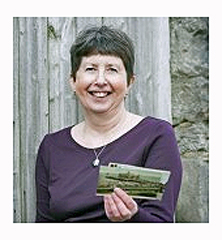
Open to the worldwide membership of Kent FHS this evening's talk was hosted by Canterbury branch.
Helen researches people and their families starting with those who sent and received some of the postcards in her collection. Her talk gave us all an insight into a different angle of family research.
Helen began her talk with the first postcard she investigated, bought by her father who was interested in the American stamp. It was sent just before WWI to a Private Gilbert Freeman, who was in the Grenadier Guards at the time. Using his regimental number, also on the card, Helen was able to find his war records and trace his family back to Freshford, near Bath.
Gilbert’s father had married twice. He had a son William by his first wife and Gilbert was one of three sons from the second marriage. Helen discovered that William had moved to Saltash, Cornwall where he was a gardener and seed merchant. Travelling to Saltash, Helen found that the Freeman name was very well known there: she was shown photographs of the shop and William himself in local archives. Gilbert himself sadly died in the Somme and is recorded on several war memorials. A photograph of a group from Chelsea Barracks came to light which claimed to have Gilbert amongst the men pictured. When Helen put up a short article on the family online, she was immediately contacted by a descendent, who confirmed that this was indeed Gilbert: another photo of the family was shared with Helen. From one postcard, Helen had uncovered the story of one family caught up in world events.
Helen found a second postcard while researching some of the Merchants who had travelled on the Mayflower. She bought a card sent to a young boy in Ontario, California USA. Several generations of Samuel Whitfields had been silversmiths of some distinction in the UK, but were gardeners when they emigrated to the US in 1895. For 32 years, the second Samuel had been a secretary to Great Ormand Street Hospital, which had opened in 1850. During his time in this role, 460,000 children were treated at the hospital. Helen found postcards sent to a couple of the children during their stay and was able to identify which families they came from, and, using the Historical Hospital Admissions Project (hharp.org) was able to find a record of their treatment.
The final postcard Helen talked about was sent to a Mrs Jones of Burdett Street, Liverpool. Helen later identified the sender as her son, Will, but his mother’s story told of an impoverished beginning, where she was sent out to work at the age of ten, being one of a very large family. Emily (later Jones) was able to send her own children to school and her son became a clerk in the docks in Liverpool.
This was a fascinating talk; we were caught up in the stories initiated by the sending of a postcard. Helen mentioned how easy it was to send these in the early years of the 20th Century. Costing a halfpenny, there were often as many as 6 collections a day, and a card sent in the morning could be received and a reply returned the same day.
Helen has written two books about the true stories behind the postcards in her collection, they are: Posted in the Past and Posted in the Past Second Delivery. She is currently preparing a third book in the series for her publishers.
This was the final talk in our Winter series of online talks. From Friday10th March we will be back to St Andrews hall for our meetings on the 2nd Friday each month: except July which will be a guided walk somewhere in East Kent.
Report by: Viv Carter