
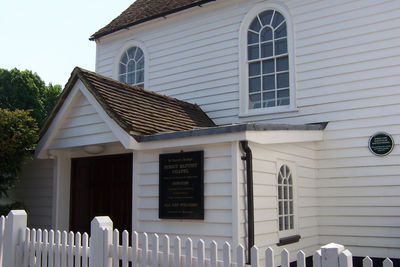
Norman Hopkins, a clergyman and author, commenced his talk and slide presentation by explaining briefly the history of nonconformity in Britain. ‘Nonconformist’ is the name generally used for Christians who are not members of the Church of England. It includes Baptists, Quakers, Unitarians, Methodists, Plymouth Brethren, Salvation Army etc.
Long before Henry VIII’s reformation the Lollards, who were followers of John Wyclif, were the first nonconformists in England. But Nonconformist sects were not accepted by the established church; which was Roman Catholic until after Henry VIII’s break from Rome. Henry broke the English church from Rome because the Pope would not grant him a divorce from Catherine of Aragon in order to marry Anne Boleyn. After Henry’s reformation England was Protestant and nonconformist groups became acceptable; a situation which continued through the reign of Henry’s son Edward VI.
The 9 year old King Edward had been educated by Protestant tutors. However, his reign was short and he was soon succeeded by his staunchly catholic sister, Mary Tudor. She restored Roman Catholicism to England and during her five year reign over 280 religious dissenters were burnt at the stake.
After Mary’s death the country once again became protestant as Elizabeth, the last of Henry VIII’s children, came to the throne. Elizabeth I had been brought up and educated in the Protestant faith but was far more tolerant of religion, than her predecessors had been.
Nonconformity flourished during the Cromwellian period and through the reign of Charles II but had to go ‘underground’ during the reign of the Catholic King James II until he was overthrown in 1688. Finally, the reign of William & Mary, saw Parliament introduce ‘The Toleration Act of 1689’. This allowed freedom of worship; from which time Nonconformists have been allowed their own places of worship and their own teachers. By the religious census of 1851 the total attendance at Nonconformist places of worship was revealed as being very close to the numbers attending Anglican churches. This census also proved that that there were several hundred different denominations in the country. In 1837 couples were legally allowed civil marriages but nonconformists had to wait until 1871 before it was finally allowed in their places of worship.
Norman continued the talk by showing slides of various nonconformist places of worship in Kent, at villages including Smarden, Marden, Cranbrook, Tilden Old Manor School etc. and he had picked out some especially for us in Canterbury too. Many buildings were several centuries old and surprisingly some even had their own burial grounds surrounding the church. Eythorne Baptist church is one of the three oldest Baptist churches and when anyone was Baptised their whole bodies had to be immersed in water; often a nearby river was used for this.
Outlining some of the various groups beliefs Norman said that although many came from the same roots distinctions about how they should worship led to congregations splitting and going their own way. Hence there are several Baptist groups. Sects such as the Strict and Particular Baptists are ‘strict’ because they believe that communion should be restricted to their own congregation. We were shown the Zoar chapel on the city wall in Canterbury which is aptly named ‘zoar ‘meaning small in Hebrew. Sketches of the ‘Pepper Pot Chapel’ once in King’s Street were shown; this was the forerunner of St Peter’s Methodist Church in Canterbury. Norman touched on the Calavnist weavers from France who made up a third of the city’s population, The Quakers and the Temperance movement. Thomas Cook of the Zion Church ran Sunday school outings for the poor of the parish which developed into the travel agents of the same name today.
This talk was extremely interesting was well received by members and the speaker knew his subject well. We were given a wide assortment of information but the talk prompted questions, many relating to member's researches, which Rev. Hopkins answered at the end of his talk.
Report by Tricia Baxter