
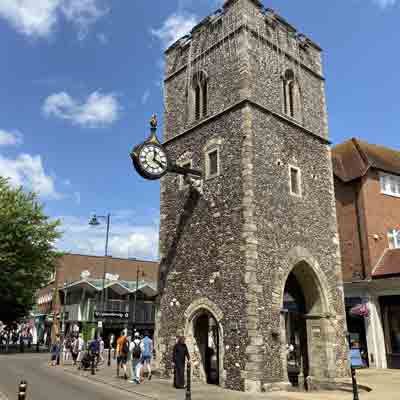
Marlowe was baptised here.
The church and his family
home opposite were
bombed in 1942
Geoff Doel gave an interesting and insightful glimpse into the life of Christopher Marlowe whose family had early links with Ospringe near Faversham and later moved to Canterbury where Marlowe spent his early years. His father John Marlowe was a shoemaker and a guild member for over 20 years. His grandfather Thomas Marlowe was also a shoemaker. John also held various positions in local parishes as a sidesman, in particular St. George's and St Andrew's and later at St. Mary Bredin. The house where the Marlowe family lived in Whitefriars stood opposite St George's church and was bombed during the Second World War.
Kit Marlowe won a scholarship and attended King's School Canterbury at the age of 14 in 1579. It is at the school where Marlowe is thought to first be involved in performing and writing plays. Marlowe further broadened his education by going up to Corpus Christi at Cambridge on a three year course which was one for secular lifestyles, but he continued for a further three years designed to prepare students for a church calling. It was while here he was translating plays from Latin. This wide education stood him in good stead for later life. During this time he made many useful contacts who would later step in and defend him when caught in various spying escapades and fights. This group included the influential friends Lord Francis Walsingham and Lord Burleigh.
Turning to Marlowe's work as a playwright, Geoff explained that, unlike his contemporary Shakespeare, he didn’t mind collaborating with other writers, and that many of his plays are co-written, Tambourline being one example. Comparisons with Shakespeare were discussed and Geoff felt Marlowe wasn’t as compassionate with his characters and that in many of his plays he showed that he was anti-Christianity; this worried the establishment and was one reason that Marlowe has not historically been studied in the same way as Shakespeare, particularly in schools. In his most famous play, Dr Faustus, Marlowe raises controversial religious beliefs and condemns Faustus to Hell.
Marlowe died in Deptford on 30th May 1593.
Geoff concluded that in his opinion Marlowe was the Master of blank verse with five beats.
Following questions, our Branch Chairman, David Wood, related how Dr William Urry, the author of 'Christopher Marlowe and Canterbury (London, 1988) went into the Albion Bookshop in Mercery Lane in the 1970s, to tell the manager that Marlowe's uncle, George Auncell, had traded from the building, and returned with documentary evidence; the unpaid bills of John Marlowe that were sent to George Auncell.
Report by Heather Bethell