
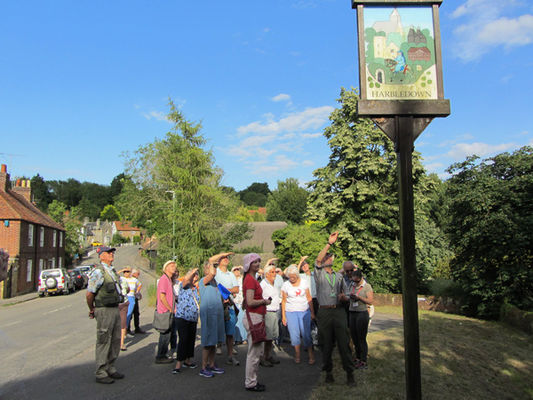
looking at the Village sign
with Guide Peter Berg
Canterbury city and Cathedral Guide Peter Berg led 30 members on a 2 hour walk in and around the village that Chaucer, in The Canterbury Tales, dubbed Bob-up-and-Doun.
"Wist ye not where ther standeth a little town which that y-clept
is Bob-up-and-Doun, under the Blee in Caunterbury weye?"
Geoffrey Chaucer, 'A Canterbury Tale'
Peter started with a short talk in the parish church of St Michael and All Angels.
He then took us on a walk through the main street of Harbledown. The road through the village was traditionally the main route into Canterbury, from London, and was used by the many thousands of pilgrims coming to the shrine of St Thomas in Canterbury Cathedral. Harbledown, is about a mile from the cathedral, and was the final resting and watering place before the pilgrims arrived in Canterbury. Peter pointed out, as we went on our way, the village’s three pubs, two now private homes, the Board School, two Manor Houses, one of which was cut off from the village when the A2 by-pass was built in the 1960s. He said that further up the hill just out of sight was Vernon Holme once the home of Thomas Sydney Cooper, the Canterbury artist, the estate is now a school.
He led us along the North Downs Way to Summer Hill where we could see Bigbury, the hill on which the iron age fort of the Cantiaci once stood. In 54BC on the fields below, Summer Hill and Bigbury, our ancestors fought and lost to the might of Rome, commanded by Julius Caesar.
Our route back to the village centre took us along the river by orchards and fields, where in the 18/19th century, cotton grew to supply a Cotton Mill in an attempt to save Canterbury’s flagging cloth industry. We continued to the Black Prince’s Well in which, legend says, Edward of Woodstock, aka the Black Prince, once bathed. The well's waters were thought to have healing properties.
Peter finished with interesting talks in the Church and the Frater of St Nicholas Hospital. Originally founded in 1084 by Archbishop Lanfranc for 60 lepers, the site is thought to be one of the oldest in the country still in use today but now as Alms Houses.
This was an interesting and enlightening afternoon thoroughly enjoyed by all and once again the weather was kind to us.
Report by Tricia Baxter